
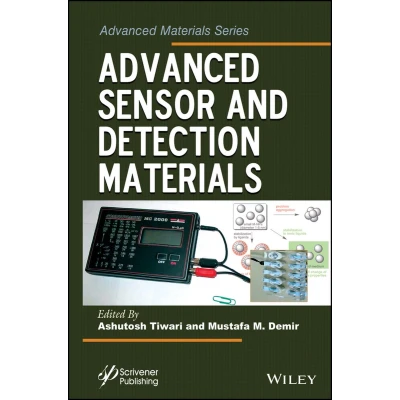
Advanced Sensor and Detection Materials
Uitgelicht

|
199,00
195,00 |
Naar shop
|
 Beschrijving
Bol
The development of sensors at macroscopic or nanometric scales in solid, liquid, or gas phases, contact or noncontact configurations, has driven the research of sensor & detection materials and technology into high gear. Presents a comprehensive and interdisciplinary review of the major cutting-edge technology research areas—especially those on new materials and methods as well as advanced structures and properties—for various sensor and detection devices The development of sensors and detectors at macroscopic or nanometric scale is the driving force stimulating research in sensing materials and technology for accurate detection in solid, liquid, or gas phases; contact or non-contact configurations; or multiple sensing. The emphasis on reduced-scale detection techniques requires the use of new materials and methods. These techniques offer appealing perspectives given by spin crossover organic, inorganic, and composite materials that could be unique for sensor fabrication. The influence of the length, composition, and conformation structure of materials on their properties, and the possibility of adjusting sensing properties by doping or adding the side-groups, are indicative of the starting point of multifarious sensing. The role of intermolecular interactions, polymer and ordered phase formation, as well as behavior under pressure and magnetic and electric fields are also important facts for processing ultra-sensing materials. The 15 chapters written by senior researchers in Advanced Sensor and Detection Materials cover all these subjects and key features under three foci: 1) principals and perspectives, 2) new materials and methods, and 3) advanced structures and properties for various sensor devices. Readership This book has been written for a large readership including researchers and university students from diverse backgrounds such as sensor and detection science, chemistry, materials science, physics, pharmacy, medical science, and biomedical engineering. It can be used not only as a textbook for both undergraduate and graduate students, but also as a review and reference book for researchers in the fields of materials science, device engineering, medicine, pharmacy, biotechnology, and nanotechnology. Presents a comprehensive and interdisciplinary review of the major cutting-edge technology research areas—especially those on new materials and methods as well as advanced structures and properties—for various sensor and detection devices The development of sensors and detectors at macroscopic or nanometric scale is the driving force stimulating research in sensing materials and technology for accurate detection in solid, liquid, or gas phases; contact or non-contact configurations; or multiple sensing. The emphasis on reduced-scale detection techniques requires the use of new materials and methods. These techniques offer appealing perspectives given by spin crossover organic, inorganic, and composite materials that could be unique for sensor fabrication. The influence of the length, composition, and conformation structure of materials on their properties, and the possibility of adjusting sensing properties by doping or adding the side-groups, are indicative of the starting point of multifarious sensing. The role of intermolecular interactions, polymer and ordered phase formation, as well as behavior under pressure and magnetic and electric fields are also important facts for processing ultra-sensing materials. The 15 chapters written by senior researchers in Advanced Sensor and Detection Materials cover all these subjects and key features under three foci: 1) principals and perspectives, 2) new materials and methods, and 3) advanced structures and properties for various sensor devices.


Vergelijk aanbieders (1)

 Beschrijving
(1)
Beschrijving
(1)
The development of sensors at macroscopic or nanometric scales in solid, liquid, or gas phases, contact or noncontact configurations, has driven the research of sensor & detection materials and technology into high gear. Presents a comprehensive and interdisciplinary review of the major cutting-edge technology research areas—especially those on new materials and methods as well as advanced structures and properties—for various sensor and detection devices The development of sensors and detectors at macroscopic or nanometric scale is the driving force stimulating research in sensing materials and technology for accurate detection in solid, liquid, or gas phases; contact or non-contact configurations; or multiple sensing. The emphasis on reduced-scale detection techniques requires the use of new materials and methods. These techniques offer appealing perspectives given by spin crossover organic, inorganic, and composite materials that could be unique for sensor fabrication. The influence of the length, composition, and conformation structure of materials on their properties, and the possibility of adjusting sensing properties by doping or adding the side-groups, are indicative of the starting point of multifarious sensing. The role of intermolecular interactions, polymer and ordered phase formation, as well as behavior under pressure and magnetic and electric fields are also important facts for processing ultra-sensing materials. The 15 chapters written by senior researchers in Advanced Sensor and Detection Materials cover all these subjects and key features under three foci: 1) principals and perspectives, 2) new materials and methods, and 3) advanced structures and properties for various sensor devices. Readership This book has been written for a large readership including researchers and university students from diverse backgrounds such as sensor and detection science, chemistry, materials science, physics, pharmacy, medical science, and biomedical engineering. It can be used not only as a textbook for both undergraduate and graduate students, but also as a review and reference book for researchers in the fields of materials science, device engineering, medicine, pharmacy, biotechnology, and nanotechnology. Presents a comprehensive and interdisciplinary review of the major cutting-edge technology research areas—especially those on new materials and methods as well as advanced structures and properties—for various sensor and detection devices The development of sensors and detectors at macroscopic or nanometric scale is the driving force stimulating research in sensing materials and technology for accurate detection in solid, liquid, or gas phases; contact or non-contact configurations; or multiple sensing. The emphasis on reduced-scale detection techniques requires the use of new materials and methods. These techniques offer appealing perspectives given by spin crossover organic, inorganic, and composite materials that could be unique for sensor fabrication. The influence of the length, composition, and conformation structure of materials on their properties, and the possibility of adjusting sensing properties by doping or adding the side-groups, are indicative of the starting point of multifarious sensing. The role of intermolecular interactions, polymer and ordered phase formation, as well as behavior under pressure and magnetic and electric fields are also important facts for processing ultra-sensing materials. The 15 chapters written by senior researchers in Advanced Sensor and Detection Materials cover all these subjects and key features under three foci: 1) principals and perspectives, 2) new materials and methods, and 3) advanced structures and properties for various sensor devices.
 Productspecificaties
| EAN |
|
|---|---|
| Maat |
|
Prijzen voor het laatst bijgewerkt op:
 Gerelateerde producten


