
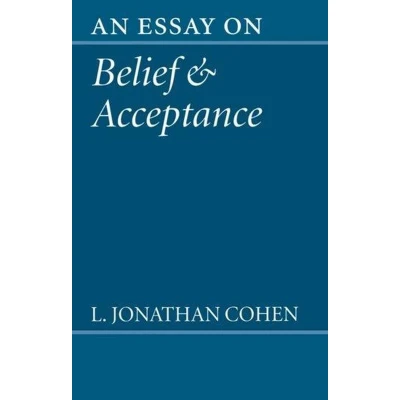
Essay On Belief And Acceptance
Uitgelicht

|
34,27 |
Naar shop
|

|
119,00
87,99 |
Naar shop
|
 Beschrijving
Bol Partner
In this original and incisive book, one of Britain's most eminent philosophers contends that those who analyse the concept of knowledge do not distinguish adequately between voluntary belief and involuntary acceptance. The distinction, elucidated by the author, turns out to be vital for understanding many important issues in epistemology, philosophy of mind, and cognitive science. In this incisive study one of Britain's most eminent philosophers explores the often overlooked tension between voluntariness and involuntariness in human cognition. He seeks to counter the widespread tendency for analytic epistemology to be dominated by the concept of belief. Is scientific knowledge properly conceived as being embodied at its best, in a passive feeling of belief or in an active policy of acceptance? Should a jury's verdict declare what its meembers involuntarily accept? And should statements and assertions be presumed to express what their authors believe or what they accept? Does such a distinction between belief and acceptance help to resolve the paradoxes of self-deception and akrasia? Must people be taken to believe everything entailed by what they believe, or merely to accept everything entailed by what they accept? Through a systematic examination of these problems, the author sheds new light on issues of crucial importance in comtemporary epistemology, philosophy of mind, and cognitive science.


 Beschrijving
(2)
Beschrijving
(2)
In this original and incisive book, one of Britain's most eminent philosophers contends that those who analyse the concept of knowledge do not distinguish adequately between voluntary belief and involuntary acceptance. The distinction, elucidated by the author, turns out to be vital for understanding many important issues in epistemology, philosophy of mind, and cognitive science. In this incisive study one of Britain's most eminent philosophers explores the often overlooked tension between voluntariness and involuntariness in human cognition. He seeks to counter the widespread tendency for analytic epistemology to be dominated by the concept of belief. Is scientific knowledge properly conceived as being embodied at its best, in a passive feeling of belief or in an active policy of acceptance? Should a jury's verdict declare what its meembers involuntarily accept? And should statements and assertions be presumed to express what their authors believe or what they accept? Does such a distinction between belief and acceptance help to resolve the paradoxes of self-deception and akrasia? Must people be taken to believe everything entailed by what they believe, or merely to accept everything entailed by what they accept? Through a systematic examination of these problems, the author sheds new light on issues of crucial importance in comtemporary epistemology, philosophy of mind, and cognitive science.
BolIn this monograph Cohen, regarded as one of Britain's most eminent philosophers, contends that those who analyze the concept of knowledge do not distinguish adequately between involuntary belief and voluntary acceptance. In this incisive new monograph one of Britain's most eminent philosophers explores the often overlooked tension between voluntariness and involuntariness in human cognition. He seeks to counter the widespread tendency for analytic epistemology to be dominated by the concept of belief. Is scientific knowledge properly conceived as being embodied, at its best, in a passive feeling of belief or in an active policy of acceptance? Should a jury's verdict declare what its members involuntarily believe or what they voluntarily accept? And should statements and assertions be presumed to express what their authors believe or what they accept? Does such a distinction between belief and acceptance help to resolve the paradoxes of self-deception and akrasia? Must people be taken to believe everything entailed by what they believe, or merely to accept everything entailed by what they accept? Through a systematic examination of these problems, the author sheds new light on issues of crucial importance in contemporary epistemology, philosophy of mind, and cognitive science.
 Productspecificaties
| EAN |
|
|---|---|
| Maat |
|
Prijzen voor het laatst bijgewerkt op:
 Gerelateerde producten


