
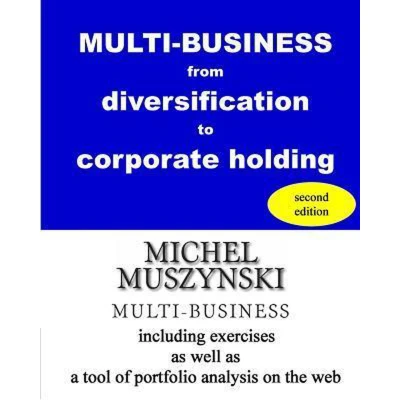
MULTI BUSINESS from diversification to corporate holding
Uitgelicht

|
46,99 |
Naar shop
|
 Beschrijving
Bol
A company is diversified when she runs two or more different businesses. The word “businesses” can refer either to lines of products or to company’s structure, however – since in the real world the corporate configuration always reflects company’s market situation - the most distinctive characteristics of diversified companies is certainly a large number of different products they sell.Many actual enterprises are in such case. In USA General Electric with thousands of products, in Japan Yamaha with several different lines of goods marketed worldwide, in France famous Vivendi – it is easy to find many good examples. The question is how different are these diversified companies comparing to single business enterprises? Does a diversified company has to be managed differently than single product businesses? How to achieve the highest profitability of portfolio of products? Are all portfolio products independent or there can exist interactions between some of them? And are there any rules concerning financing of growing products by those which are in the advanced stages of the life cycle?Finally, separating different businesses of a diversified company leads to building what is called “holding” organizational structure. Each of components of an holding corporation is an independent company, having a full autonomy, a proper statute, a separate management and very often also separate facilities. One thing is only common: the capital. How to manage this? Do holdings have any sort of advantage against simple diversified companies?This book is for managers working on corporate strategy and for students of MBA programs. It gives the access to a tool of portfolio analysis downloadable from the Web.TABLE OF CONTENTS:DIVERSIFICATION1.1 Higher profits with increased number of products1.2 Smother evolution of company’s cash flows1.3 Full exploitation of the market1.4 A more efficient use of company’s assets1.5 The risk and the diversification1.6 Diversify or not?A DIVERSIFIED COMPANY2.1 Products and their life cycles2.2 Products interdependence2.3 Products and their financial margins2.4 Products and financial flows they generate2.5 Portfolio equilibrium2.6 Helping the “emerging” products 2.7 The evolution of market share2.8 Portfolio risk and reward2.9 Managing portfolio2.10 Adding new products to portfolio2.11 Organizing a diversified companyHOLDINGS3.1 Why holdings?3.2 Parent company3.3 Subsidiaries and diversification3.4 Financial management3.5 Holdings and international operations3.6 Conglomerates3.7 MergersThe author


Vergelijk aanbieders (1)

 Beschrijving
(1)
Beschrijving
(1)
A company is diversified when she runs two or more different businesses. The word “businesses” can refer either to lines of products or to company’s structure, however – since in the real world the corporate configuration always reflects company’s market situation - the most distinctive characteristics of diversified companies is certainly a large number of different products they sell.Many actual enterprises are in such case. In USA General Electric with thousands of products, in Japan Yamaha with several different lines of goods marketed worldwide, in France famous Vivendi – it is easy to find many good examples. The question is how different are these diversified companies comparing to single business enterprises? Does a diversified company has to be managed differently than single product businesses? How to achieve the highest profitability of portfolio of products? Are all portfolio products independent or there can exist interactions between some of them? And are there any rules concerning financing of growing products by those which are in the advanced stages of the life cycle?Finally, separating different businesses of a diversified company leads to building what is called “holding” organizational structure. Each of components of an holding corporation is an independent company, having a full autonomy, a proper statute, a separate management and very often also separate facilities. One thing is only common: the capital. How to manage this? Do holdings have any sort of advantage against simple diversified companies?This book is for managers working on corporate strategy and for students of MBA programs. It gives the access to a tool of portfolio analysis downloadable from the Web.TABLE OF CONTENTS:DIVERSIFICATION1.1 Higher profits with increased number of products1.2 Smother evolution of company’s cash flows1.3 Full exploitation of the market1.4 A more efficient use of company’s assets1.5 The risk and the diversification1.6 Diversify or not?A DIVERSIFIED COMPANY2.1 Products and their life cycles2.2 Products interdependence2.3 Products and their financial margins2.4 Products and financial flows they generate2.5 Portfolio equilibrium2.6 Helping the “emerging” products 2.7 The evolution of market share2.8 Portfolio risk and reward2.9 Managing portfolio2.10 Adding new products to portfolio2.11 Organizing a diversified companyHOLDINGS3.1 Why holdings?3.2 Parent company3.3 Subsidiaries and diversification3.4 Financial management3.5 Holdings and international operations3.6 Conglomerates3.7 MergersThe author
 Productspecificaties
| EAN |
|
|---|---|
| Maat |
|
Prijzen voor het laatst bijgewerkt op:
 Gerelateerde producten


