
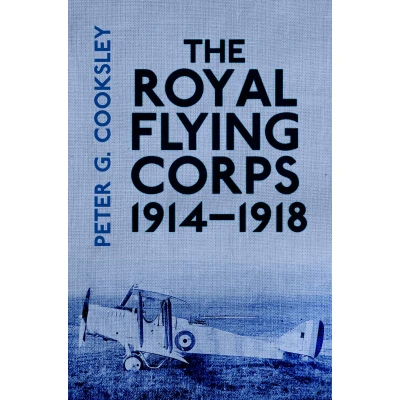
The Royal Flying Corps 1914 18
Uitgelicht

|
25,99 |
Naar shop
|
 Beschrijving
Bol
During the First World War Britain’s Royal Flying Corps (RFC) and Royal Naval Air Service (RNAS) fought alongside one another in the greatest conflict mankind had ever experienced. During the First World War Britain’s Royal Flying Corps (RFC) and Royal Naval Air Service (RNAS) fought alongside one another in the greatest conflict mankind had ever experienced. This period was also one of dramatic technological advances, in which both air arms made significant contributions to the development of air interception and strategic bombing. The RFC and RNAS were the precursors of arguably the finest, most efficient, and certainly the oldest, independent air arm in the world – the Royal Air Force. In the late nineteenth century, both the British Army and the Royal Navy were seriously considering the viability of air support, mainly for reconnaissance and surveillance duties. By 1912, the Royal Flying Corps was formed, combining the Air Battalion of the Royal Engineers and the Naval Air Organization, and embracing a Central Flying School and Royal Aircraft Factory. Two years later, just over a month before the outbreak of the First World War, the Royal Naval Air Service was created as an independent unit. At this stage it was already predicted that battles for supremacy of the air by armed aircraft were only a matter of time. The Royal Flying Corps 1914–1918 explores a wide range of subjects, from aircraft, airships, balloons and motor vehicles to pay, rank, the women’s branches, uniforms and even the origins of the RAF’s eagle badge. Peter Cooksley’s authoritative text is complemented by many previously unpublished photographs, line drawings and maps.


Vergelijk aanbieders (1)

 Beschrijving
(1)
Beschrijving
(1)
During the First World War Britain’s Royal Flying Corps (RFC) and Royal Naval Air Service (RNAS) fought alongside one another in the greatest conflict mankind had ever experienced. During the First World War Britain’s Royal Flying Corps (RFC) and Royal Naval Air Service (RNAS) fought alongside one another in the greatest conflict mankind had ever experienced. This period was also one of dramatic technological advances, in which both air arms made significant contributions to the development of air interception and strategic bombing. The RFC and RNAS were the precursors of arguably the finest, most efficient, and certainly the oldest, independent air arm in the world – the Royal Air Force. In the late nineteenth century, both the British Army and the Royal Navy were seriously considering the viability of air support, mainly for reconnaissance and surveillance duties. By 1912, the Royal Flying Corps was formed, combining the Air Battalion of the Royal Engineers and the Naval Air Organization, and embracing a Central Flying School and Royal Aircraft Factory. Two years later, just over a month before the outbreak of the First World War, the Royal Naval Air Service was created as an independent unit. At this stage it was already predicted that battles for supremacy of the air by armed aircraft were only a matter of time. The Royal Flying Corps 1914–1918 explores a wide range of subjects, from aircraft, airships, balloons and motor vehicles to pay, rank, the women’s branches, uniforms and even the origins of the RAF’s eagle badge. Peter Cooksley’s authoritative text is complemented by many previously unpublished photographs, line drawings and maps.
 Productspecificaties
| EAN |
|
|---|---|
| Maat |
|
Prijzen voor het laatst bijgewerkt op:
 Gerelateerde producten


