


€ 34,99 Gratis verzending

Uitgelicht
|
|
34,99 |
Naar shop
|

|
37,48 |
Naar shop
|
| VERGELIJK ALLE AANBIEDERS (2) | ||
 Beschrijving
Vergelijk aanbieders (2)
€ 34,99 Gratis verzending
€ 37,48 Gratis verzending
Winkels met andere maten
Beschrijving
(1)
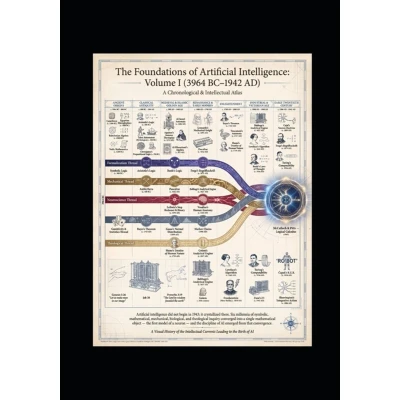
Volume I of A Developmental History of Artificial Intelligence reconstructs the full intellectual prehistory of AI across nearly six thousand years of human thought. Rather than beginning the story in 1943 or 1956, this work demonstrates that artificial intelligence emerged from the long convergence of five independent traditions: symbolic representation, mathematics, logic, mechanical computation, neuroscience, and theological inquiry into intelligence, agency, and creation.Drawing from 245 curated entries-including ancient Near Eastern mathematics, Greek logic, Islamic algebra, medieval scholasticism, Renaissance automata, Enlightenment rationalism, Victorian engineering, early probability theory, and foundational neuroscience-this volume shows how humanity progressively formalized reasoning, externalized calculation, and interrogated the nature of mind. The book also integrates biblical and theological sources as legitimate intellectual contributions, revealing how early reflections on intelligence, alignment, moral agency, and creation shaped later scientific developments.The narrative is organized into seven eras, each documenting the breakthroughs that prepared the world for artificial intelligence: from cuneiform algorithms and Euclid's geometry to Babbage's Analytical Engine, Hollerith's tabulator, and the electrophysiological discoveries that made neural modeling possible. The volume concludes in 1942, the final year before Warren McCulloch and Walter Pitts unified these threads into the first mathematical model of a neuron-crystallizing AI as a scientific discipline.This book provides scholars, engineers, theologians, and historians with a comprehensive, citation-verified foundation for understanding artificial intelligence not as a sudden invention, but as the culmination of humanity's oldest questions about thought, mechanism, and creation.
 Prijshistorie
 * Prijshistorie bevat geen data van Amazon.
Prijzen voor het laatst bijgewerkt op:
 Gerelateerde resultaten
 Productspecificaties


