








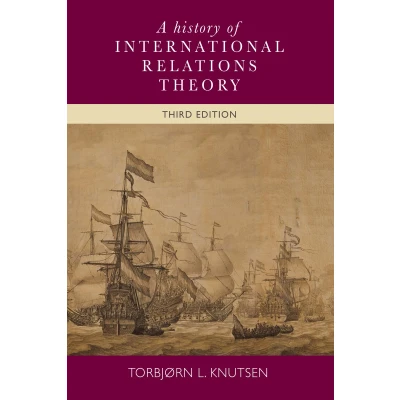
A history of International Relations theory
Uitgelicht

|
24,99
23,75 |
Naar shop
|

|
27,45 |
Naar shop
|
 Beschrijving
Bol Partner
Introduces ideas on international relations expressed by thinkers from High Middle Ages to the present day Torbjørn L. Knutsen introduces ideas on international relations expressed by thinkers from High Middle Ages to the present day and traces the development of four ever-present themes: war, peace, wealth and power. The book counters the view that international relations has no theoretical tradition and shows that scholars, soldiers and statesmen have been speculating about the subject for the last 700 years. Beginning with the roots of the state and the concept of sovereignty in the Middle Ages, the author draws upon the insights of outstanding political thinkers. Clearly and succinctly the theories of Aquinas, Machiavelli, Hegel, Rousseau, Bentham, Marx and Lenin amongst others are discussed and analysed. The ideas of these thinkers are placed in context with the societies and intellectual ideas that produced them. The text is fully revised and updated to include the place of international relations after the Cold War and new ways of thinking opened up by developments in information technology. Torbjørn L. Knutsen introduces ideas on international relations expressed by thinkers from High Middle Ages to the present day and traces the development of four ever-present themes: war, peace, wealth and power. The book counters the view that international relations has no theoretical tradition and shows that scholars, soldiers and statesmen have been speculating about the subject for the last 700 years. Beginning with the roots of the state and the concept of sovereignty in the Middle Ages, the author draws upon the insights of outstanding political thinkers – from Machiavelli and Hobbes to Hegel, Rousseau, and Marx and contemporary thinkers such as Woodrow Wilson, Lenin, Morgenthau and Walt – who profoundly influenced the emergence of a discrete discipline of international relations in the twentieth century. Fully revised and updated, the final section embraces more recent approaches to the study of international relations, most notably postmodernism and ecologism.


 Beschrijving
(2)
Beschrijving
(2)
Introduces ideas on international relations expressed by thinkers from High Middle Ages to the present day Torbjørn L. Knutsen introduces ideas on international relations expressed by thinkers from High Middle Ages to the present day and traces the development of four ever-present themes: war, peace, wealth and power. The book counters the view that international relations has no theoretical tradition and shows that scholars, soldiers and statesmen have been speculating about the subject for the last 700 years. Beginning with the roots of the state and the concept of sovereignty in the Middle Ages, the author draws upon the insights of outstanding political thinkers. Clearly and succinctly the theories of Aquinas, Machiavelli, Hegel, Rousseau, Bentham, Marx and Lenin amongst others are discussed and analysed. The ideas of these thinkers are placed in context with the societies and intellectual ideas that produced them. The text is fully revised and updated to include the place of international relations after the Cold War and new ways of thinking opened up by developments in information technology. Torbjørn L. Knutsen introduces ideas on international relations expressed by thinkers from High Middle Ages to the present day and traces the development of four ever-present themes: war, peace, wealth and power. The book counters the view that international relations has no theoretical tradition and shows that scholars, soldiers and statesmen have been speculating about the subject for the last 700 years. Beginning with the roots of the state and the concept of sovereignty in the Middle Ages, the author draws upon the insights of outstanding political thinkers – from Machiavelli and Hobbes to Hegel, Rousseau, and Marx and contemporary thinkers such as Woodrow Wilson, Lenin, Morgenthau and Walt – who profoundly influenced the emergence of a discrete discipline of international relations in the twentieth century. Fully revised and updated, the final section embraces more recent approaches to the study of international relations, most notably postmodernism and ecologism.
BolThis introduction to International Relations theory, now in its third edition, shows how discussions of war, wealth, peace and power stretch back well over 500 years. It shows how ancient ideas still effect the way we perceive world politics. By placing international arguments, perspectives, terms and theories in their proper historical setting, it traces the evolution of International Relations theory in context. Beginning with the emergence of the territorial state in the Middle Ages, the book follows the international ideas of sages, statesmen and scholars. It discusses early theories about the sovereign nature of the state. It demonstrates how contract philosophers like Hobbes, Locke and Rousseau paved the way for the modern analysis of international relations. It shows how Enlightenment theorists followed up with balance-of-power theory and perpetual-peace projects. It seeks to demonstrate that the contemporary science of International Relations is the outcome of a long evolution and how its core concepts and major theories have been deeply affected by international events along the way while also showing that basic ideas have remained remarkably constant over the centuries. This has been a top selling title for a number of years and this new edition is keenly awaited.
 Productspecificaties
| EAN |
|
|---|---|
| Maat |
|
 Prijshistorie
Prijzen voor het laatst bijgewerkt op:
 Gerelateerde resultaten


