
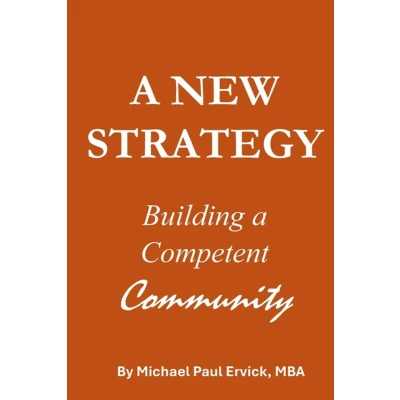
a New Strategy: Building Competent Community
Uitgelicht

|
9,03 |
Naar shop
|

|
9,03 |
Naar shop
|

|
10,50 |
Naar shop
|
| VERGELIJK ALLE AANBIEDERS (3) | ||
 Beschrijving
Bol
A New Strategy is the second book in Michael Paul Ervick's series following Sarah Chen, a practitioner of community-based infrastructure. Where the first book (We the People) built the model - mutual aid, distributed competence, Tuesday dinners as proof of concept - this one translates it into a corporate setting and asks a harder question: can something that works at a human scale survive inside an institution? Sarah is now VP of Operational Excellence at Sysdigm Industries in 2038, fifteen years after the community work that defined her. The company she joined is being gradually hollowed out by David Brennan, a CFO who arrived with genuine competence - catching real problems, saving real money - but applied financial control logic to operations, which runs on different physics. The result is a system that is perfectly coherent and structurally destructive: six approvals to fix an $18,000-per-hour production failure using a $2,400 part. Sarah's response is not to argue but to prove. She designs a thirty-day pilot - one team, minimal approvals, authority following demonstrated competence - and instruments it carefully against a control group still running the old framework. The results are unambiguous. The book follows her from that first data point through the political resistance, the expansion to multiple lines, the final board presentation, and the institutional change that follows. The intellectual spine is Deming and Shewhart's quality systems theory, introduced through Marcus Webb, a retired quality engineer, whom Sarah meets at her daughter's school concert. He gives the framework a name - what Sarah built in neighborhoods is statistical process control applied to human systems - and the book uses that lineage to argue that the competence-versus-control tension isn't a personality conflict or a management fad. It's a structural choice with measurable consequences. The closing argument is that the pattern holds across every domain where it has been tested: neighborhoods, corporations, markets, and institutions. The book ends on an open note - the pattern is still moving, and Sarah can now recognize it anywhere.


 Beschrijving
(1)
Beschrijving
(1)
A New Strategy is the second book in Michael Paul Ervick's series following Sarah Chen, a practitioner of community-based infrastructure. Where the first book (We the People) built the model - mutual aid, distributed competence, Tuesday dinners as proof of concept - this one translates it into a corporate setting and asks a harder question: can something that works at a human scale survive inside an institution? Sarah is now VP of Operational Excellence at Sysdigm Industries in 2038, fifteen years after the community work that defined her. The company she joined is being gradually hollowed out by David Brennan, a CFO who arrived with genuine competence - catching real problems, saving real money - but applied financial control logic to operations, which runs on different physics. The result is a system that is perfectly coherent and structurally destructive: six approvals to fix an $18,000-per-hour production failure using a $2,400 part. Sarah's response is not to argue but to prove. She designs a thirty-day pilot - one team, minimal approvals, authority following demonstrated competence - and instruments it carefully against a control group still running the old framework. The results are unambiguous. The book follows her from that first data point through the political resistance, the expansion to multiple lines, the final board presentation, and the institutional change that follows. The intellectual spine is Deming and Shewhart's quality systems theory, introduced through Marcus Webb, a retired quality engineer, whom Sarah meets at her daughter's school concert. He gives the framework a name - what Sarah built in neighborhoods is statistical process control applied to human systems - and the book uses that lineage to argue that the competence-versus-control tension isn't a personality conflict or a management fad. It's a structural choice with measurable consequences. The closing argument is that the pattern holds across every domain where it has been tested: neighborhoods, corporations, markets, and institutions. The book ends on an open note - the pattern is still moving, and Sarah can now recognize it anywhere.
 Productspecificaties
 Prijshistorie
* Prijshistorie bevat geen data van Amazon, Amazon Marketplace.
Prijzen voor het laatst bijgewerkt op:
 Gerelateerde resultaten


