








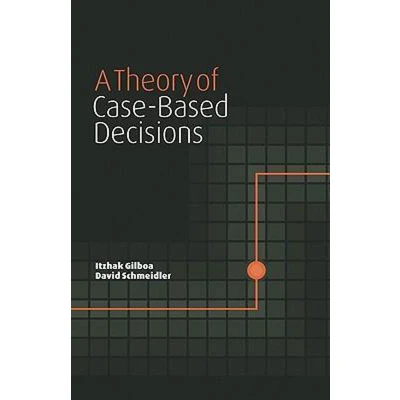
A Theory of Case Based Decisions
Uitgelicht

|
53,99
51,04 |
Naar shop
|
 Beschrijving
Bol
Gilboa and Schmeidler provide a new paradigm for modeling decision making under uncertainty, one which suggests that people make decisions by analogies to past cases. The authors describe the general theory and its relationship to planning, repeated choice problems, inductive inference, and learning. Gilboa and Schmeidler provide a paradigm for modelling decision making under uncertainty. Unlike the classical theory of expected utility maximization, case-based decision theory does not assume that decision makers know the possible 'states of the world' or the outcomes, let alone the decision matrix attaching outcomes to act-state pairs. Case-based decision theory suggests that people make decisions by analogies to past cases: they tend to choose acts that performed well in the past in similar situations, and to avoid acts that performed poorly. It is an alternative to expected utility theory when both states of the world and probabilities are neither given in the problem nor can be easily constructed. The authors describe the general theory and its relationship to planning, repeated choice problems, inductive inference, and learning; they highlight its mathematical and philosophical foundations and compare it with expected utility theory as well as with rule-based systems.


Vergelijk aanbieders (1)

 Beschrijving
(1)
Beschrijving
(1)
Gilboa and Schmeidler provide a new paradigm for modeling decision making under uncertainty, one which suggests that people make decisions by analogies to past cases. The authors describe the general theory and its relationship to planning, repeated choice problems, inductive inference, and learning. Gilboa and Schmeidler provide a paradigm for modelling decision making under uncertainty. Unlike the classical theory of expected utility maximization, case-based decision theory does not assume that decision makers know the possible 'states of the world' or the outcomes, let alone the decision matrix attaching outcomes to act-state pairs. Case-based decision theory suggests that people make decisions by analogies to past cases: they tend to choose acts that performed well in the past in similar situations, and to avoid acts that performed poorly. It is an alternative to expected utility theory when both states of the world and probabilities are neither given in the problem nor can be easily constructed. The authors describe the general theory and its relationship to planning, repeated choice problems, inductive inference, and learning; they highlight its mathematical and philosophical foundations and compare it with expected utility theory as well as with rule-based systems.
 Productspecificaties
| EAN |
|
|---|---|
| Maat |
|
 Prijshistorie
Prijzen voor het laatst bijgewerkt op:
 Gerelateerde resultaten


