

€ 16,68 Gratis verzending

Gesponsorde links
|
|
16,68 |
Naar shop
|

|
16,68 |
Naar shop
|

|
18,00 |
Naar shop
|
| VERGELIJK ALLE AANBIEDERS (3) | ||
 Beschrijving
Vergelijk aanbieders (3)
Gesponsorde links · Sommige shops betalen ons een vergoeding
€ 16,68 Gratis verzending
€ 16,68 Gratis verzending
€ 18,00 € 2,99 verzendkosten Totaal € 20,99
Winkels met andere maten
Beschrijving
(1)
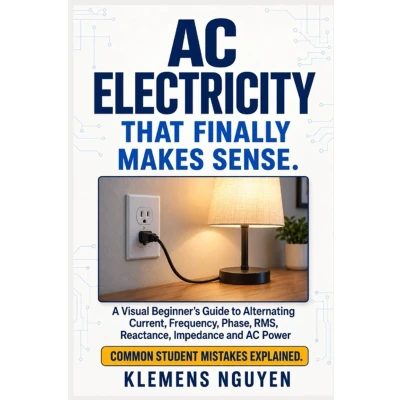
AC electricity finally explained in a way that actually makes sense.You may know the formulas.You may have learned about frequency, RMS voltage, phase, reactance, impedance, capacitors, inductors, and power factor.But do you really understand what is happening inside an AC circuit?AC Electricity That Finally Makes Sense is a visual, beginner-friendly guide for students, technicians, hobbyists, and self-learners who want to understand alternating current instead of simply memorizing equations.Starting with the basic question-what does "alternating" actually mean?-the book builds AC theory step by step using clear explanations, practical examples, visual thinking, and easy-to-understand analogies.Inside, you will learn: - what alternating current really means - what a sine wave is actually showing - how frequency and period are related - the difference between instantaneous, peak, peak-to-peak, and RMS voltage - what phase, leading, and lagging really mean - why voltage and current are in phase in a resistor - why a capacitor can pass AC but block steady DC - why current leads voltage in a capacitor - why current lags voltage in an inductor - how capacitive and inductive reactance change with frequency - the difference between resistance, reactance, and impedance - how Ohm's law works in AC circuits - what happens when resistance, inductance, and capacitance are combined - how RLC circuits and resonance work - what reactive power is actually doing - the difference between real, reactive, and apparent power - what power factor means and why it mattersThis book is designed to build intuition before formulas.Instead of presenting rules to memorize, it repeatedly explains why the circuit behaves the way it does.Difficult concepts are broken down with physical analogies, visual explanations, numerical examples, and sections devoted to the mistakes students make most often.You will see why: 230 V RMS is not 230 V peak.A capacitor's opposition decreases as frequency increases.An inductor behaves in the opposite way.Impedance is more than resistance.Voltage and current can be out of phase even when they have the same frequency.Reactive power can matter even when it does not perform useful work in the load.Each chapter builds naturally on the previous one, taking you from the meaning of AC to impedance, resonance, and AC power without unnecessary complexity.If you have ever thought, "I studied AC circuits, but I still don't really understand them," this book was written for you.Learn what the formulas mean.Build the mental picture.Make AC electricity finally make sense.
 Prijshistorie
* Prijshistorie bevat geen data van Amazon, Amazon Marketplace.
Prijzen voor het laatst bijgewerkt op:
 Gerelateerde resultaten
 Productspecificaties


