


€ 155,00 Gratis verzending

Uitgelicht
|
|
155,00 |
Naar shop
|
| VERGELIJK ALLE AANBIEDERS (1) | ||
 Beschrijving
Vergelijk aanbieders (1)
€ 155,00 Gratis verzending
Winkels met andere maten
Beschrijving
(1)
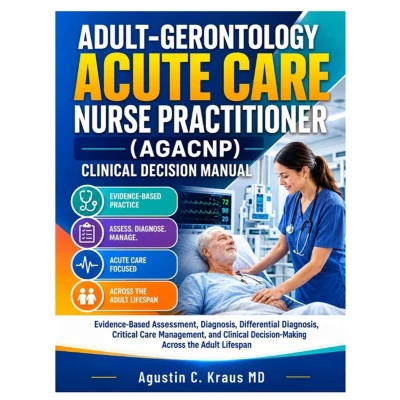
You know the medicine. That's not the problem.The problem is bed 12 at 3 a.m. The patient doesn't look right, and you can't say why.You've read the guidelines. You still hesitated.The vitals are technically normal. Your gut disagrees. You don't know which one to trust.You ordered the labs. Now you're second-guessing the labs.You want to escalate, but you don't want to be the NP who calls for everything.Here's what nobody told you: this isn't a knowledge gap.School taught you diseases one at a time - fully formed, neatly packaged, diagnosis printed at the top of the page. Real patients don't arrive that way. They arrive halfway through, unlabeled, with five other problems and a medication list two pages long.You weren't taught badly. You were taught in a way that doesn't match the bedside.Acute care isn't a memory test. It's a sequence.The clinicians who look calm under pressure aren't recalling more than you. They're following an order of operations - the same one, every time, until it becomes reflex.That sequence is what this manual gives you.Picture your next shift with a process you trust. You know what to check first. You know which dangerous diagnosis to rule out before you rule out anything comfortable. You know when to reassess and what a good response actually looks like. And when you pick up the phone, you know exactly what to say.No dense paragraphs to decode.No assuming you already know.No wasted pages.By the end, you'll be able to: - Work a hypotensive patient in a fixed order instead of freezing- Catch the older adult deteriorating quietly, before the vitals catch up- Choose which diagnosis to exclude first, and why that order matters- Adjust doses in failing kidneys without guessing- Recognize delirium instead of writing it off as baseline confusion- Tell the difference between "watch closely" and "call now"- Hand off a patient so cleanly the next clinician doesn't have to start overYou go from I think I know what's happening, but I don't know what to do next to I know my next three moves and I know why.Written for AGACNP students, first-year acute care nurse practitioners, bedside nurses stepping into the role, and preceptors who need a shared framework to teach from.You will learn this either way. The only question is whether you learn it here, in advance - or on shift, with a real patient, at real cost.Open the chapter that scares you most. Start there.
 Productspecificaties
| EAN |
|
|---|---|
| Maat |
|
 Prijshistorie
 Prijzen voor het laatst bijgewerkt op:
 Gerelateerde resultaten


