

€ 168,55 Gratis verzending

Uitgelicht
|
|
168,55 |
Naar shop
|

|
194,88 |
Naar shop
|
| VERGELIJK ALLE AANBIEDERS (2) | ||
 Beschrijving
Vergelijk aanbieders (2)
€ 168,55 Gratis verzending
€ 194,88 Gratis verzending
Winkels met andere maten
Beschrijving
(1)
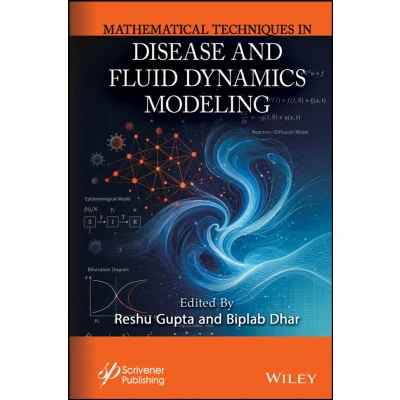
By integrating classical mathematical foundations with cutting-edge machine learning and high-performance computing, this definitive guide provides the complete toolkit needed to translate complex fluid mechanics and epidemiological theory into actionable, real-world solutions. The complexities of disease dynamics and fluid mechanics pose significant challenges in fields ranging from public health to environmental management. Understanding the spread of infectious diseases, optimizing control strategies, and modeling biological processes require interdisciplinary approaches that combine mathematical modeling, computational tools, and practical applications. This book provides a unified framework that bridges theoretical foundations, computational methods, and practical applications, resolving the disconnect between mathematical modeling and real-world problem-solving by introducing readers to core principles like conservation laws, Navier-Stokes equations, and epidemiological models while advancing their understanding through topics such as bifurcation analysis, stochastic modeling, and machine learning. Practical approaches, including numerical methods, optimization, and data-driven analytics, enable readers to tackle real-world challenges, such as airborne and waterborne pathogen spread, pollution modeling, and vaccination strategies. The book integrates classical techniques like perturbation and fractional calculus with cutting-edge methods like machine learning and high-performance computing, offering a comprehensive toolkit for interdisciplinary research. By combining traditional techniques with contemporary computational tools, this book equips readers to address complex problems in disease and fluid dynamics modeling effectively. By integrating classical mathematical foundations with cutting-edge machine learning and high-performance computing, this definitive guide provides the complete toolkit needed to translate complex fluid mechanics and epidemiological theory into actionable, real-world solutions. The complexities of disease dynamics and fluid mechanics pose significant challenges in fields ranging from public health to environmental management. Understanding the spread of infectious diseases, optimizing control strategies, and modeling biological processes require interdisciplinary approaches that combine mathematical modeling, computational tools, and practical applications. This book provides a unified framework that bridges theoretical foundations, computational methods, and practical applications, resolving the disconnect between mathematical modeling and real-world problem-solving by introducing readers to core principles like conservation laws, Navier-Stokes equations, and epidemiological models while advancing their understanding through topics such as bifurcation analysis, stochastic modeling, and machine learning. Practical approaches, including numerical methods, optimization, and data-driven analytics, enable readers to tackle real-world challenges, such as airborne and waterborne pathogen spread, pollution modeling, and vaccination strategies. The book integrates classical techniques like perturbation and fractional calculus with cutting-edge methods like machine learning and high-performance computing, offering a comprehensive toolkit for interdisciplinary research. By combining traditional techniques with contemporary computational tools, this book equips readers to address complex problems in disease and fluid dynamics modeling effectively.
 Prijshistorie
 * Prijshistorie bevat geen data van Amazon.
Prijzen voor het laatst bijgewerkt op:
 Gerelateerde resultaten
 Productspecificaties


