
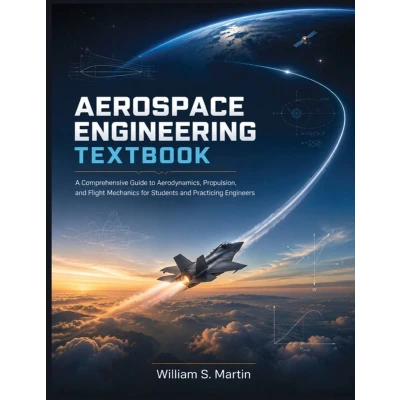
Aerospace Engineering Textbook: A Comprehensive Guide to Aerodynamics, Propulsion, and Flight Mechanics for Students Practicing Engineers
Uitgelicht

|
84,99 |
Naar shop
|

|
93,09 |
Naar shop
|

|
93,09 |
Naar shop
|
| VERGELIJK ALLE AANBIEDERS (3) | ||
 Beschrijving
Bol
Flight asks a single machine to obey many laws at once - the air that lifts a wing, the heat inside an engine, the loads a structure must carry, and the gravity that shapes an orbit. Understanding how those laws combine, quantitatively, is what turns memorised formulas into real engineering judgment. Aerospace engineering is usually met as a stack of separate courses and books - aerodynamics here, propulsion there, structures and orbital mechanics elsewhere - each with its own notation. When a real question arrives (how fast, how far, how heavy, how stable), the pieces are hard to assemble, and it is easy to lose track of where a result came from. This comprehensive single-volume guide develops the whole subject one principle at a time and then shows how the principles combine. It builds each topic from first principles, carries every quantity in consistent SI units, and puts theory to work in fully solved examples before offering practice problems with worked answers. Inside this guide you will: - Follow a cumulative path from the flight environment and aerodynamics through performance, structures, propulsion, orbital mechanics, and vehicle design.- Practise real calculations - lift and drag, climb and range, stress and margin of safety, engine cycles, and orbital velocity change - with units tracked at every step.- Study one consistent notation across aeronautics and astronautics instead of reconciling several separate textbooks.- Reinforce learning with chapter objectives, solved examples, and practice problems whose answers are shown.- Keep a cross-referenced desk reference, supported by standard-atmosphere, physical-constant, material-property, and orbital data tables.Some of the topics treated: The standard atmosphere and flight environment; airfoil, wing, and compressible aerodynamics; aircraft performance, stability, and flight dynamics; aerospace materials, structures, and aeroelasticity; air-breathing and rocket propulsion; orbital mechanics and astrodynamics; spacecraft systems; guidance, navigation, avionics, and control; and aircraft design synthesis, testing, and certification. Who is this book for? Undergraduate students meeting the subject for the first time, graduate students consolidating their foundations, and practising engineers who want a coherent single-volume reference. It assumes only a working knowledge of calculus, elementary physics, and introductory mechanics. Add this comprehensive resource to your library and begin building a connected, quantitative understanding of flight - one worked principle at a time.


 Beschrijving
(1)
Beschrijving
(1)
Flight asks a single machine to obey many laws at once - the air that lifts a wing, the heat inside an engine, the loads a structure must carry, and the gravity that shapes an orbit. Understanding how those laws combine, quantitatively, is what turns memorised formulas into real engineering judgment. Aerospace engineering is usually met as a stack of separate courses and books - aerodynamics here, propulsion there, structures and orbital mechanics elsewhere - each with its own notation. When a real question arrives (how fast, how far, how heavy, how stable), the pieces are hard to assemble, and it is easy to lose track of where a result came from. This comprehensive single-volume guide develops the whole subject one principle at a time and then shows how the principles combine. It builds each topic from first principles, carries every quantity in consistent SI units, and puts theory to work in fully solved examples before offering practice problems with worked answers. Inside this guide you will: - Follow a cumulative path from the flight environment and aerodynamics through performance, structures, propulsion, orbital mechanics, and vehicle design.- Practise real calculations - lift and drag, climb and range, stress and margin of safety, engine cycles, and orbital velocity change - with units tracked at every step.- Study one consistent notation across aeronautics and astronautics instead of reconciling several separate textbooks.- Reinforce learning with chapter objectives, solved examples, and practice problems whose answers are shown.- Keep a cross-referenced desk reference, supported by standard-atmosphere, physical-constant, material-property, and orbital data tables.Some of the topics treated: The standard atmosphere and flight environment; airfoil, wing, and compressible aerodynamics; aircraft performance, stability, and flight dynamics; aerospace materials, structures, and aeroelasticity; air-breathing and rocket propulsion; orbital mechanics and astrodynamics; spacecraft systems; guidance, navigation, avionics, and control; and aircraft design synthesis, testing, and certification. Who is this book for? Undergraduate students meeting the subject for the first time, graduate students consolidating their foundations, and practising engineers who want a coherent single-volume reference. It assumes only a working knowledge of calculus, elementary physics, and introductory mechanics. Add this comprehensive resource to your library and begin building a connected, quantitative understanding of flight - one worked principle at a time.
 Productspecificaties
 Prijshistorie
* Prijshistorie bevat geen data van Amazon, Amazon Marketplace.
Prijzen voor het laatst bijgewerkt op:
 Gerelateerde resultaten


