
AFTER THE GUARANTOR
Uitgelicht

|
31,99 |
Naar shop
|

|
35,06 |
Naar shop
|

|
35,06 |
Naar shop
|
| VERGELIJK ALLE AANBIEDERS (3) | ||
 Beschrijving
Bol
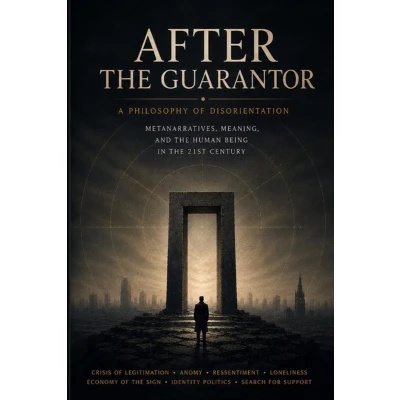
Some conditions of a culture cannot be given a date. A Treatise on the Guarantor is devoted to one of them. For centuries a supra-personal authority stood surety for the meaning of a human life and for its measure; the author keeps the old word of suretyship for this authority and calls it the Guarantor. The word is meant literally. A promissory note that someone has backed circulates on a par with money; the same note, once the backer withdraws, keeps its signatures and its face value, while the force has gone out of it. The author holds that exactly this has happened to our highest values: the words about what one owes are still pronounced, and the binding force has left them. God, Reason, History, Progress, and the Market succeed one another in the same place. The book reads them as consecutive guises of a single guaranteeing function, as different names of one surety. When the function is withdrawn, the place it occupied does not vanish with it. It stays vacant, and for that reason it draws surrogates. From here the treatise follows the hollowing downward. From the metaphysical event that Nietzsche called the death of God, the book descends to the economy of the sign and the world-system, then to the society of the spectacle and the algorithm, to the psychopolitics of the depleted subject, to the anomie of morals, to the aesthetics of the smooth surface, and at last to a law whose ground has been knocked out. The descent is not arbitrary. At every step the same figure is laid bare: an abundance of means amid a hunger for ends. The author holds a conversation with Kant, Nietzsche, Durkheim, Weber, Baudrillard, Debord, Heidegger, Agamben, Taylor, Blumenberg, Habermas, Buber, and Levinas. He does not rehearse their claims. He takes the strongest version of each objection, including the objection against himself, and answers it before it can be raised. The end of the treatise neither consoles nor despairs. The answer is twofold and hard. An orientation that does not pass itself off as final is possible; yet it is possible only at the cost of the very durability for which one usually turns to orientation. Binding force does not arise from a new absolute prop replacing the one withdrawn. It arises from within a practice of promising older than anyone who promises. From this follows the book's central demand: no sacrifices may be offered for an orientation. The Guarantor demanded sacrifices precisely because it passed itself off as the last word.


 Beschrijving
(1)
Beschrijving
(1)
Some conditions of a culture cannot be given a date. A Treatise on the Guarantor is devoted to one of them. For centuries a supra-personal authority stood surety for the meaning of a human life and for its measure; the author keeps the old word of suretyship for this authority and calls it the Guarantor. The word is meant literally. A promissory note that someone has backed circulates on a par with money; the same note, once the backer withdraws, keeps its signatures and its face value, while the force has gone out of it. The author holds that exactly this has happened to our highest values: the words about what one owes are still pronounced, and the binding force has left them. God, Reason, History, Progress, and the Market succeed one another in the same place. The book reads them as consecutive guises of a single guaranteeing function, as different names of one surety. When the function is withdrawn, the place it occupied does not vanish with it. It stays vacant, and for that reason it draws surrogates. From here the treatise follows the hollowing downward. From the metaphysical event that Nietzsche called the death of God, the book descends to the economy of the sign and the world-system, then to the society of the spectacle and the algorithm, to the psychopolitics of the depleted subject, to the anomie of morals, to the aesthetics of the smooth surface, and at last to a law whose ground has been knocked out. The descent is not arbitrary. At every step the same figure is laid bare: an abundance of means amid a hunger for ends. The author holds a conversation with Kant, Nietzsche, Durkheim, Weber, Baudrillard, Debord, Heidegger, Agamben, Taylor, Blumenberg, Habermas, Buber, and Levinas. He does not rehearse their claims. He takes the strongest version of each objection, including the objection against himself, and answers it before it can be raised. The end of the treatise neither consoles nor despairs. The answer is twofold and hard. An orientation that does not pass itself off as final is possible; yet it is possible only at the cost of the very durability for which one usually turns to orientation. Binding force does not arise from a new absolute prop replacing the one withdrawn. It arises from within a practice of promising older than anyone who promises. From this follows the book's central demand: no sacrifices may be offered for an orientation. The Guarantor demanded sacrifices precisely because it passed itself off as the last word.
 Productspecificaties
 Prijshistorie
* Prijshistorie bevat geen data van Amazon, Amazon Marketplace.
Prijzen voor het laatst bijgewerkt op:
 Gerelateerde resultaten


