


€ 25,99 Gratis verzending

Uitgelicht
|
|
25,99 |
Naar shop
|

|
27,73 |
Naar shop
|
| VERGELIJK ALLE AANBIEDERS (2) | ||
 Beschrijving
Vergelijk aanbieders (2)
€ 25,99 Gratis verzending
€ 27,73 Gratis verzending
Winkels met andere maten
Beschrijving
(1)
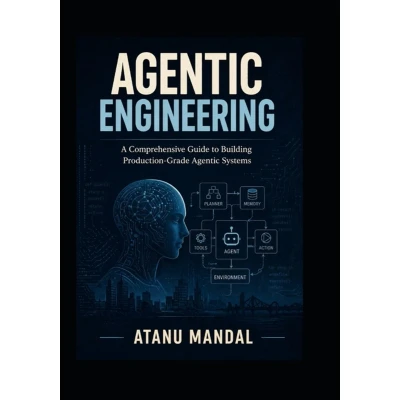
Language models demo impressively. Engineering them for enterprise production is a different job entirely. Modern engineering teams face a fundamental shift: systems that are probabilistic, stateful, tool-using, and occasionally wrong in fluent, convincing prose. Building Enterprise Agentic AI Systems is a systems-first guide to designing, building, and operating agentic AI that survives production traffic, security review, compliance, and 2 a.m. incidents - not just demo day. This is not a prompting book. It treats large language models as black-box probabilistic components inside larger software architectures, and focuses on the part of the job that actually determines whether a system survives contact with production: the control surfaces around the model - context and memory, tool permissions, multi-agent coordination, evaluation, security, and cost. Who this book is for: - Engineers and developers moving from prompt experiments to production-grade AI system architecture - Architects and tech leads designing system boundaries, tool integration, reliability, and governance patterns >What's inside: - Foundations - how agentic systems differ from deterministic software, and how to think in terms of blast radius, not just correctness - Building blocks - context engineering and memory, tool calling (including MCP), planning and reflection, and multi-agent architecture done with restraint instead of hype - Enterprise engineering - reliability and evaluation, performance and cost engineering, security and compliance (prompt injection, data leakage, governance), and what it actually takes to deploy and operate these systems at scale - Advanced topics - fine-tuning versus prompting, and a practical map of today's AI engineering ecosystem >Every chapter opens with a real engineering problem, not a buzzword, and pairs the concept with working code across LangGraph, Microsoft Agent Framework, and CrewAI - so the ideas are never abstract for long. By the end, you won't just know how to build an agent that works in a demo. You'll know when to reach for full autonomy versus a deterministic workflow, how to defend a tool-using pipeline against the failure modes that only show up in production, and how to move a prototype to something you can trust - and explain - in front of a compliance review. If you're responsible for AI systems that have to actually work, not just impress a room, this book is for you.
 Prijshistorie
 * Prijshistorie bevat geen data van Amazon.
Prijzen voor het laatst bijgewerkt op:
 Gerelateerde resultaten
 Productspecificaties


