

€ 27,28 Gratis verzending

Uitgelicht
|
|
27,28 |
Naar shop
|

|
27,28 |
Naar shop
|

|
28,99 |
Naar shop
|
| VERGELIJK ALLE AANBIEDERS (3) | ||
 Beschrijving
Vergelijk aanbieders (3)
€ 27,28 Gratis verzending
€ 27,28 Gratis verzending
€ 28,99 Gratis verzending
Winkels met andere maten
Beschrijving
(1)
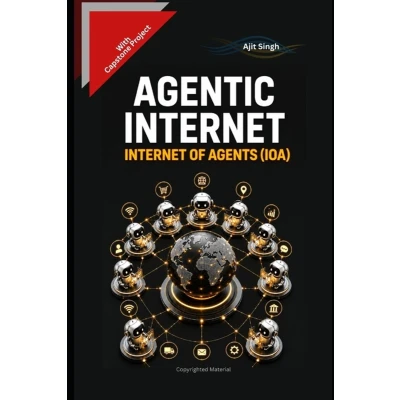
Agentic Internet: Internet of Agents (IoA) is a definitive, comprehensive, and highly practical engineering book designed to bridge the gap between artificial intelligence theory and real-world software production. As the digital ecosystem rapidly evolves toward Web 4.0, industry demands are shifting from traditional web development to the orchestration of autonomous AI agents. This book provides a rigorous, step-by-step methodology for designing, building, deploying, and maintaining these agentic networks from scratch. Philosophy >Key Features 1. The 4-Layer Architecture Model: Deep, actionable explorations of the Human Intent Layer, the Personal Agent Layer, the Agent Network Layer (The New Internet), and the Settlement Layer. 2. Implementation of Cutting-Edge Protocols: Practical guides on utilizing Google's A2A (Agent-to-Agent) Protocol for inter-agent communication, and Anthropic's MCP (Model Context Protocol) for integrating agents with external tools like Gmail, Calendars, and enterprise APIs. 3. Agent Identity and Finance: Comprehensive setups for Agent IDs (Aadhaar/Identity for agents) and Agent Wallets, enabling agents to execute financial transactions via UPI or Crypto independently. 4. Agent Discovery Mechanisms: Implementing the equivalent of Microsoft's Agent Store, allowing agents to broadcast their services, read business cards, and discover other agents autonomously. 5. 100% Practical Capstone: A final chapter dedicated entirely to a live, DIY project featuring the complete working code for a multi-agent travel planning system, bringing every concept together into a production-ready application. Key Takeaways By the conclusion of this book, readers will possess the ability to: 1. Comprehensively understand the evolution of the web, specifically the transition into Web 4.0 (The Internet of Agents). 2. Design and build intelligent Personal Agents that can autonomously translate human intent into actionable computational tasks. 3. Implement secure, robust Agent-to-Agent (A2A) communication protocols, allowing multiple agents to negotiate, collaborate, and execute complex workflows in milliseconds. 4. Integrate third-party tools via the Model Context Protocol (MCP) to grant agents the ability to read emails, check databases, and trigger external APIs. 5. Establish autonomous settlement systems, allowing agents to transact with one another using digital Agent Wallets and verifiable Agent IDs. 6. Deploy, monitor, and scale multi-agent networks in live, production-grade cloud environments. 7. Possess a fully functional, real-world multi-agent Capstone application that can be used as a portfolio piece or customized for enterprise deployment. Disclaimer: Earnest request from the Author. Kindly go through the table of contents and refer kindle edition for a glance on the related contents. Thank you for your kind consideration!
 Prijshistorie
* Prijshistorie bevat geen data van Amazon, Amazon Marketplace.
Prijzen voor het laatst bijgewerkt op:
 Gerelateerde resultaten
 Productspecificaties


