


€ 105,00 Gratis verzending

Uitgelicht
|
|
105,00 |
Naar shop
|

|
110,84 |
Naar shop
|

|
110,84 |
Naar shop
|
| VERGELIJK ALLE AANBIEDERS (3) | ||
 Beschrijving
Vergelijk aanbieders (3)
€ 105,00 Gratis verzending
€ 110,84 Gratis verzending
€ 110,84 Gratis verzending
Winkels met andere maten
Beschrijving
(1)
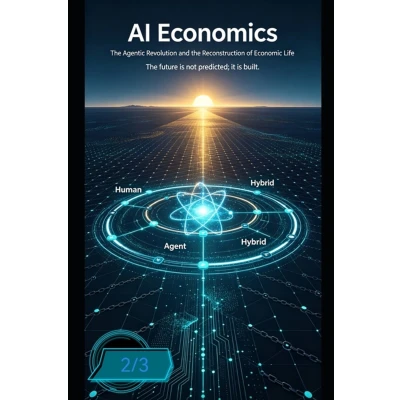
What happens when autonomous AI agents stop being tools and become economic subjects? This is the question at the heart of AI Economics, a three-volume work that reconstructs economics for a world in which cognition, judgment, creativity, and coordination are externalized into agentic systems.The book argues that the agentic revolution is not another digital upgrade. It is a paradigm shift. The economic subject becomes a triad: the human atom, the agent atom, and the hybrid atom. Production is rebuilt around data, compute, algorithms, models, tokens, and trust capital. Value is created through labor, algorithm, and synergy-not labor alone. Property becomes programmable; trust becomes algorithmic; exchange moves through smart contracts and elastic chains; governance becomes constitutional, with separation of power, human veto, and kill switches.But this transformation is pharmacological: every remedy is also a poison. Algorithmic efficiency brings cognitive dependence; programmable property brings new enclosures; agent autonomy brings logic monopoly and existential risk. The work confronts these tensions through distributive justice-contribution, compensation, participation-and through three scenarios: weak AI, strong AI, and superintelligence. It explores platform capitalism, data colonialism, compute sovereignty, US-China adaptive radiation, and the rise of new-quality industries: compute markets, energy internet, time banking, and DeSci.At its core, AI Economics defends an unexteriorizable human core-suffering, death, love, and the meta-capacity for re-internalization. It offers a vision of the Atomic Commonwealth: a civilization of programmable bonds, just institutions, and human-machine symbiosis. It refuses both techno-utopia and doom. Instead, it issues an invitation: to understand the agentic economy, to engage its governance, and to shape its future. The fire of Prometheus burns on. Will we tend it wisely?
 Prijshistorie
 * Prijshistorie bevat geen data van Amazon, Amazon Marketplace.
Prijzen voor het laatst bijgewerkt op:
 Gerelateerde resultaten
 Productspecificaties


