


€ 216,00 Gratis verzending

Uitgelicht
|
|
216,00 |
Naar shop
|

|
222,60 |
Naar shop
|

|
222,60 |
Naar shop
|
| VERGELIJK ALLE AANBIEDERS (3) | ||
 Beschrijving
Vergelijk aanbieders (3)
€ 216,00 Gratis verzending
€ 222,60 Gratis verzending
€ 222,60 Gratis verzending
Winkels met andere maten
Beschrijving
(1)
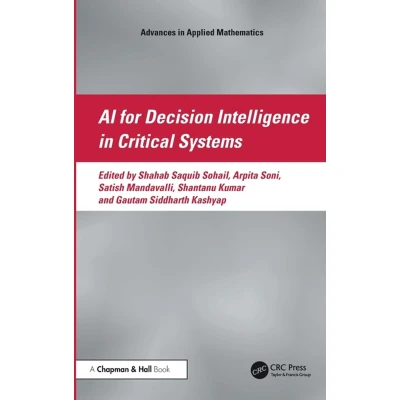
This edited book is a multi-disciplinary reference on how domain-aware AI models can outperform generic approaches by addressing sector-specific complexities. It is for academics and researchers in computer science, AI, and data science; industry professionals in transportation, software engineering, finance; and policymakers. This book is a multi-disciplinary reference on how domain-aware artificial intelligence (AI) models can outperform generic approaches by addressing sector-specific complexities. It offers comparative frameworks, reproducible case studies, and real-world applications of emerging AI methods. Collectively, AI for Decision Intelligence in Critical Systems emphasizes a unifying theme: the effective deployment of AI to strengthen decision-making, enhance system reliability, and mitigate risks in domains where precision, trust, and efficiency are critical. This edited volume brings together twenty-one chapters of original research, each exploring how AI, machine learning (ML), and deep learning (DL) are shaping innovation across critical domains. The book highlights the application of advanced architectures—including Convolutional Neural Networks (CNNs), Quaternion Neural Networks (QCNNs), Large Language Models (LLMs), and Gradient-Boosted Decision Trees (GBDTs)—to solve complex, domain-specific challenges. Concerning computer vision and infrastructure safety, chapters discuss the use of CNNs and QCNNs for automated road crack detection, offering scalable approaches to improving transportation safety while reducing dependence on manual inspections. With regard to software engineering, contributions focus on leveraging ML, DL, and LLMs to enhance software quality assurance, minimize defects, and improve resilience in high-stakes industries. Additional chapters examine ML-driven methods, particularly GBDT, to uncover non-linear drivers of equity valuation across sectors, supporting more accurate forecasts and risk-sensitive decision-making. Academics and researchers in computer science, AI, and data science, industry professionals in transportation, software engineering, finance, and policymakers seeking to apply AI systems effectively will find this book useful.
 Prijshistorie
 * Prijshistorie bevat geen data van Amazon, Amazon Marketplace.
Prijzen voor het laatst bijgewerkt op:
 Gerelateerde resultaten
 Productspecificaties


