
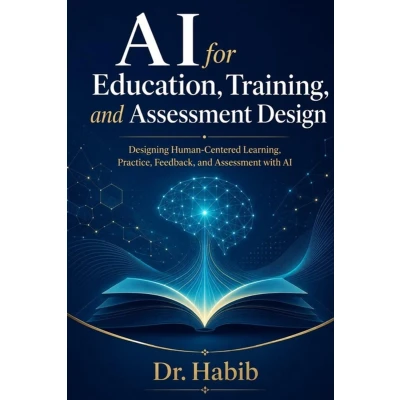
AI for Education, Training, and Assessment Design: Designing Human-Centered Learning, Practice, Feedback, with
Uitgelicht

|
25,79 |
Naar shop
|

|
32,09 |
Naar shop
|

|
32,09 |
Naar shop
|
| VERGELIJK ALLE AANBIEDERS (3) | ||
 Beschrijving
Bol
Artificial intelligence is already changing how lessons are planned, training materials are prepared, feedback is delivered, and learning is assessed, yet speed alone does not guarantee sound education. AI for Education, Training, and Assessment Design offers a clear and disciplined guide for educators, instructional designers, trainers, assessment specialists, learning leaders, consultants, and institutions that want to introduce AI without weakening accuracy, learner independence, accessibility, privacy, fairness, or professional responsibility. The book begins with the questions that should come before any tool decision, including what learning result is expected, which tasks are suitable for AI support, who remains responsible for the final judgment, which sources can be trusted, and what evidence should be kept for review. Readers are guided through the full operating system behind AI-supported education, including learners, educators, curriculum sources, platforms, workflows, assessment rules, human review, data protection, and organizational controls. Detailed chapters explain how to select suitable tasks, compare tools, design learning activities, produce varied practice, prepare formative feedback, develop assessment items, protect scoring validity, set clear rules for permitted AI assistance, and test whether learners can perform independently. Realistic cases show how weak source control, misleading output, inaccessible design, excessive assistance, hidden data use, unfair scoring, or unclear authority can damage an otherwise promising initiative. Reusable templates, scorecards, checklists, workflow records, risk registers, readiness reviews, and implementation plans help readers turn ideas into documented decisions that colleagues and reviewers can examine. Special attention is given to human judgment, learner choice, authentic evidence of learning, correction routes, incident response, cost, workload, tool changes, supplier conditions, and the ability to pause or retire a system when the evidence no longer supports its use. Whether the reader is testing a single classroom activity, redesigning workplace training, reviewing an assessment program, or planning institution-wide adoption, this book provides a structured way to connect educational purpose with responsible AI support. The result is a complete reference for building learning and assessment practices in which technology assists the work while qualified people remain answerable for the quality, fairness, and consequences of every educational decision.


 Beschrijving
(1)
Beschrijving
(1)
Artificial intelligence is already changing how lessons are planned, training materials are prepared, feedback is delivered, and learning is assessed, yet speed alone does not guarantee sound education. AI for Education, Training, and Assessment Design offers a clear and disciplined guide for educators, instructional designers, trainers, assessment specialists, learning leaders, consultants, and institutions that want to introduce AI without weakening accuracy, learner independence, accessibility, privacy, fairness, or professional responsibility. The book begins with the questions that should come before any tool decision, including what learning result is expected, which tasks are suitable for AI support, who remains responsible for the final judgment, which sources can be trusted, and what evidence should be kept for review. Readers are guided through the full operating system behind AI-supported education, including learners, educators, curriculum sources, platforms, workflows, assessment rules, human review, data protection, and organizational controls. Detailed chapters explain how to select suitable tasks, compare tools, design learning activities, produce varied practice, prepare formative feedback, develop assessment items, protect scoring validity, set clear rules for permitted AI assistance, and test whether learners can perform independently. Realistic cases show how weak source control, misleading output, inaccessible design, excessive assistance, hidden data use, unfair scoring, or unclear authority can damage an otherwise promising initiative. Reusable templates, scorecards, checklists, workflow records, risk registers, readiness reviews, and implementation plans help readers turn ideas into documented decisions that colleagues and reviewers can examine. Special attention is given to human judgment, learner choice, authentic evidence of learning, correction routes, incident response, cost, workload, tool changes, supplier conditions, and the ability to pause or retire a system when the evidence no longer supports its use. Whether the reader is testing a single classroom activity, redesigning workplace training, reviewing an assessment program, or planning institution-wide adoption, this book provides a structured way to connect educational purpose with responsible AI support. The result is a complete reference for building learning and assessment practices in which technology assists the work while qualified people remain answerable for the quality, fairness, and consequences of every educational decision.
 Productspecificaties
 Prijshistorie
* Prijshistorie bevat geen data van Amazon, Amazon Marketplace.
Prijzen voor het laatst bijgewerkt op:
 Gerelateerde resultaten


