


€ 43,99 Gratis verzending

Gesponsorde links
|
|
43,99 |
Naar shop
|

|
46,18 |
Naar shop
|

|
46,18 |
Naar shop
|
| VERGELIJK ALLE AANBIEDERS (3) | ||
 Beschrijving
Vergelijk aanbieders (3)
Gesponsorde links · Sommige shops betalen ons een vergoeding
€ 43,99 Gratis verzending
€ 46,18 Gratis verzending
€ 46,18 Gratis verzending
Winkels met andere maten
Beschrijving
(1)
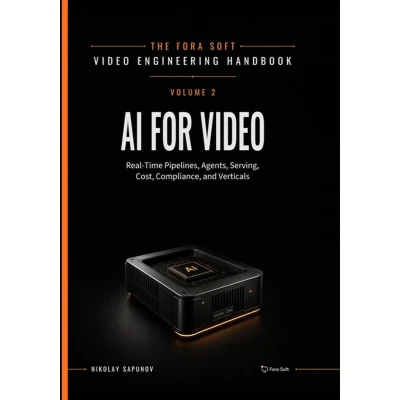
The same capabilities, under a real-time budget - then in production, then in a market.A model that takes four seconds is useless in a call. A demo that works is not a feature that ships. Volume 1 built the capabilities; this volume runs them: inside a live call at millisecond budgets, orchestrated by agents, served under cost and latency constraints, inside a regulatory regime, and assembled into products in three verticals.It opens with real time - the latency budget of a call, where AI can be inserted in a WebRTC pipeline, in-call video and audio AI, live captions and translation, and moderation on the fly. Then agents, treated as engineering rather than magic: the loop primitives, the frameworks, agents inside video products, and their evaluation, safety and cost. Then operations: production evaluation, inference serving, edge deployment with distillation and quantization, cost optimization, and the regulatory engineering that the EU AI Act and its neighbours now demand. It closes with three vertical playbooks - communications and health, media and entertainment, security and industry - and a chapter on the AI tools a video engineer uses on their own work.Every topic reads on its top layer without mathematics and is still accurate; the rigorous layer sits underneath, in boxes you can skip. Each chapter ends with review questions, problems, and a lab you run on Python, a serving stack and open models.What is inside- AI in real time - the latency budget, WebRTC insertion points, in-call video and audio AI, live captions and translation, real-time moderation- Agents - loop primitives, frameworks, agents in video products, evaluation, safety and cost- Operating video AI - production evaluation, inference serving, edge, distillation and quantization, cost optimization, regulatory engineering- Assembling products - communications and health, media and entertainment, security and industry, and the engineer's own AI toolsWho it is forEngineers who own an AI feature in production, WebRTC developers adding intelligence to a call, and technical leads answering for latency, spend and compliance. A short bridge chapter recaps Volume 1, so this volume can be read on its own.20 chapters, 7 appendices, 148 figures, a 354-entry bibliography, an 800-entry glossary and index, and 20 labs. Book 7 of 7, Volume 2, in The Fora Soft Video Engineering Handbook.Nikolay Sapunov is CEO and co-founder of Fora Soft, which has built video, real-time and AI systems since 2005: 250+ delivered projects, a 50-engineer team, systems used by NBC, Coca-Cola and Red Bull. This series is the training the company uses on its own engineers.
 Prijshistorie
* Prijshistorie bevat geen data van Amazon, Amazon Marketplace.
Prijzen voor het laatst bijgewerkt op:
 Gerelateerde resultaten
 Productspecificaties


