


€ 60,99 Gratis verzending

Uitgelicht
|
|
60,99 |
Naar shop
|

|
65,51 |
Naar shop
|

|
65,51 |
Naar shop
|
| VERGELIJK ALLE AANBIEDERS (3) | ||
 Beschrijving
Vergelijk aanbieders (3)
€ 60,99 Gratis verzending
€ 65,51 Gratis verzending
€ 65,51 Gratis verzending
Winkels met andere maten
Beschrijving
(1)
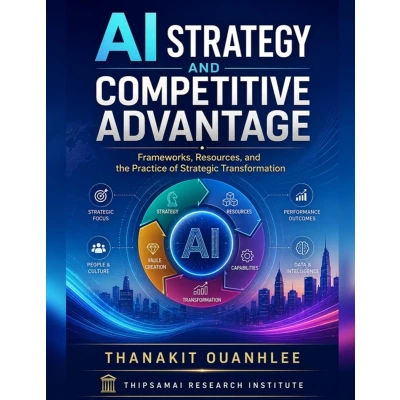
The strategic question survives the arrival of AI. Many of its answers do not. AI Strategy and Competitive Advantage is a postgraduate textbook for the leaders, analysts, and MBA and executive-education students who must think clearly about competition in an era when the cost of prediction is collapsing, industry boundaries are dissolving, and the tempo of strategic revision has shifted from the annual cycle toward something closer to continuous. Its premise is disciplined rather than breathless. The question strategy has always asked - why some firms outperform others over sustained periods, and how their leaders can deliberately produce that result - remains intact. What changes is the terrain on which it is answered. This book equips the reader to tell the difference between an AI capability that confers durable advantage and one that merely impresses, and to act on the distinction. Across seventeen chapters and seven thematic parts, the book builds a complete analytical apparatus and then shows it in use: - The inherited architecture, re-examined - Porter's positioning school, the resource-based view, dynamic capabilities, blue-ocean thinking, disruptive innovation, and Rumelt's discipline of good strategy, each assessed for where it still holds and where it strains under AI-era conditions.- The strategic resources that actually matter - a VRIO-grounded treatment of data, models, talent, and infrastructure, and the data-advantage paradox: why accumulating data does not, by itself, produce sustained advantage.- Diagnosis and positioning - the AI Readiness Maturity Model, Porter's Five Forces extended to dissolving industry boundaries, and generic strategies reworked for a world of symmetric adoption.- Capability, ecosystems, and execution - the build-buy-partner decision, the AI operating model, a phased implementation roadmap, the three-lines and five-domain governance apparatus, the AI capability stack, and a balanced-scorecard approach to measuring strategic impact.- A capstone that asks the reader to assemble these elements into an integrative AI Strategy Document for an organisation of their own choosing.The book is deliberately global in its outlook. Its composite teaching scenarios are set in boardrooms and markets from Doha and Phnom Penh to Lagos, Nairobi, and Ulaanbaatar, treating emerging-economy strategy as central rather than peripheral. Every chapter closes with reflection questions, self-assessment exercises, key terms, and further reading, and the argument is illustrated throughout by twenty-nine purpose-built figures. For readers who want frameworks they can defend, apply, and build on - not slogans - this is a textbook written to be used.
 Prijshistorie
 * Prijshistorie bevat geen data van Amazon, Amazon Marketplace.
Prijzen voor het laatst bijgewerkt op:
 Gerelateerde resultaten
 Productspecificaties


