
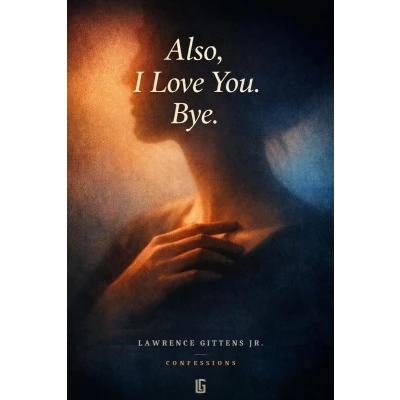
Also, I Love You. Bye.: Confessions
Uitgelicht

|
3,98 |
Naar shop
|

|
10,65 |
Naar shop
|

|
10,65 |
Naar shop
|
| VERGELIJK ALLE AANBIEDERS (3) | ||
 Beschrijving
Bol
Also, I Love You. Bye.: Confessions by Lawrence Gittens Jr. is a slim, confessional novel-in-letters - a collection of twenty-seven unsent letters arranged into a five-part arc: The Finding, The Wanting, The Breaking, The After, and The Letting Go. The framing belongs to the author. The epigraph, signed "- Lawrence," is addressed to someone he calls only N.: a person he met, married a life to, and lost without thunder or blame. He says he never found the language for what happened between them, so he wrote around it - and these letters are the wreckage of that attempt. But what follows isn't memoir. Each letter is voiced by a different invented character writing to a different absent person: a man on a commuter train who fell in love with a stranger's collarbone; a thirty-four-year-old writing to the high school girl he was too afraid to answer; a woman whose marriage has become furniture; a mother choosing whether to set a place at the table for her dead husband; a father apologizing to the daughter he watched get married without ever saying the right thing. Some letters are written in motion (on a Notes app, in a parked car); some are written in the small hours; one - "Dear Hands" - is a letter to the writer's own hands. The throughline is the gap between what people felt and what they managed to say. Almost no one in these pages got the words out in time. The book sits with that - the rooms left unentered, the texts unsent, the apologies that arrive forty years late or never. It returns repeatedly to the same instruments: a single sentence withheld, a marriage honoring a contract the heart cancelled, a child being taught that need is a wound, the small ordinary objects (a grocery aisle, a horoscope, a coffee cup beside the trash bin) that become unbearable in retrospect. The recurring fragment "Also, I love you. Bye." - the throwaway sign-off of a phone call you didn't know was the last one - gives the book its title and its argument: that love often arrives disguised as the most casual sentence in the conversation, and only later announces what it was.


 Beschrijving
(1)
Beschrijving
(1)
Also, I Love You. Bye.: Confessions by Lawrence Gittens Jr. is a slim, confessional novel-in-letters - a collection of twenty-seven unsent letters arranged into a five-part arc: The Finding, The Wanting, The Breaking, The After, and The Letting Go. The framing belongs to the author. The epigraph, signed "- Lawrence," is addressed to someone he calls only N.: a person he met, married a life to, and lost without thunder or blame. He says he never found the language for what happened between them, so he wrote around it - and these letters are the wreckage of that attempt. But what follows isn't memoir. Each letter is voiced by a different invented character writing to a different absent person: a man on a commuter train who fell in love with a stranger's collarbone; a thirty-four-year-old writing to the high school girl he was too afraid to answer; a woman whose marriage has become furniture; a mother choosing whether to set a place at the table for her dead husband; a father apologizing to the daughter he watched get married without ever saying the right thing. Some letters are written in motion (on a Notes app, in a parked car); some are written in the small hours; one - "Dear Hands" - is a letter to the writer's own hands. The throughline is the gap between what people felt and what they managed to say. Almost no one in these pages got the words out in time. The book sits with that - the rooms left unentered, the texts unsent, the apologies that arrive forty years late or never. It returns repeatedly to the same instruments: a single sentence withheld, a marriage honoring a contract the heart cancelled, a child being taught that need is a wound, the small ordinary objects (a grocery aisle, a horoscope, a coffee cup beside the trash bin) that become unbearable in retrospect. The recurring fragment "Also, I love you. Bye." - the throwaway sign-off of a phone call you didn't know was the last one - gives the book its title and its argument: that love often arrives disguised as the most casual sentence in the conversation, and only later announces what it was.
 Productspecificaties
 Prijshistorie
* Prijshistorie bevat geen data van Amazon, Amazon Marketplace.
Prijzen voor het laatst bijgewerkt op:
 Gerelateerde resultaten


