
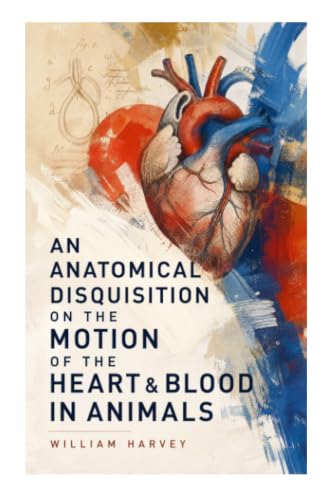
An Anatomical Disquisition on the Motion of Heart & Blood in Animals
Uitgelicht

|
10,80 |
Naar shop
|

|
10,80 |
Naar shop
|

|
10,80 |
Naar shop
|
| VERGELIJK ALLE AANBIEDERS (3) | ||
 Beschrijving
Bol
An Anatomical Disquisition on the Motion of the Heart & Blood in Animals is one of the decisive works of early modern science. Through anatomical observation, vivisection, experiment, and numerical inference, Harvey argues that the heart functions as a muscular pump and that blood circulates continuously through the body. Its prose is terse, forensic, and demonstrative, replacing inherited Galenic physiology with a method grounded in repeated observation. In the context of the seventeenth-century scientific revolution, the book exemplifies the transition from scholastic authority to experimental natural philosophy. William Harvey (1578-1657), educated at Cambridge and at Padua under the anatomist Hieronymus Fabricius, brought together classical learning, surgical practice, and a disciplined attention to bodily mechanisms. As physician to James I and Charles I, and as a lecturer at the College of Physicians, he had unusual access to comparative anatomy and clinical experience. His formation in Paduan anatomy and dissatisfaction with traditional explanations clearly shaped this bold inquiry. This book is indispensable for readers interested in medicine, biology, intellectual history, or the origins of experimental reasoning. It rewards close reading as both a landmark scientific argument and a model of disciplined skepticism.


 Beschrijving
(1)
Beschrijving
(1)
An Anatomical Disquisition on the Motion of the Heart & Blood in Animals is one of the decisive works of early modern science. Through anatomical observation, vivisection, experiment, and numerical inference, Harvey argues that the heart functions as a muscular pump and that blood circulates continuously through the body. Its prose is terse, forensic, and demonstrative, replacing inherited Galenic physiology with a method grounded in repeated observation. In the context of the seventeenth-century scientific revolution, the book exemplifies the transition from scholastic authority to experimental natural philosophy. William Harvey (1578-1657), educated at Cambridge and at Padua under the anatomist Hieronymus Fabricius, brought together classical learning, surgical practice, and a disciplined attention to bodily mechanisms. As physician to James I and Charles I, and as a lecturer at the College of Physicians, he had unusual access to comparative anatomy and clinical experience. His formation in Paduan anatomy and dissatisfaction with traditional explanations clearly shaped this bold inquiry. This book is indispensable for readers interested in medicine, biology, intellectual history, or the origins of experimental reasoning. It rewards close reading as both a landmark scientific argument and a model of disciplined skepticism.
 Productspecificaties
 Prijshistorie
* Prijshistorie bevat geen data van Amazon, Amazon Marketplace.
Prijzen voor het laatst bijgewerkt op:
 Gerelateerde resultaten


