
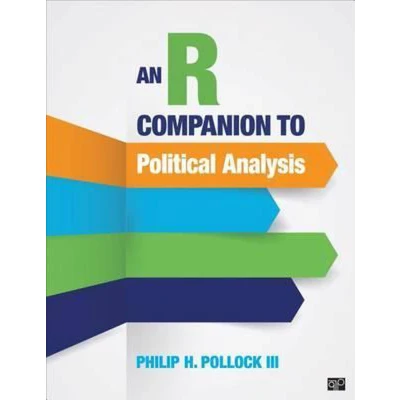
An R Companion to Political Analysis
Uitgelicht

|
29,05 |
Naar shop
|

|
49,99 |
Naar shop
|
| VERGELIJK ALLE AANBIEDERS (2) | ||
 Beschrijving
Bol
The Third Edition of An R Companion to Political Analysis by Philip H. Pollock III and Barry C. Edwards teaches your students to conduct political research with R, the open-source programming language and software environment for statistical computing and graphics. This workbook offers the same easy-to-use and effective style as the other software companions to the Essentials of Political Analysis, tailored for R. With this comprehensive workbook, students analyze research-quality data to learn descriptive statistics, data transformations, bivariate analysis (such as cross-tabulations and mean comparisons), controlled comparisons, correlation and bivariate regression, interaction effects, and logistic regression. The clear explanations and instructions are aided by the use of many annotated and labeled screen shots, as well as QR codes linking to demonstration videos. The many end-of-chapter exercises allow students to apply their new skills. The Third Edition includes new and revised exercises, along with new and updated datasets from the 2020 American National Election Study, an experiment dataset, and two aggregate datasets, one on 50 U.S. states and one based on countries of the world. A new structure helps break up individual elements of political analysis for deeper explanation while an updated suite of R functions makes using R even easier. Students will gain valuable skills learning to analyze political data in R.


 Beschrijving
(2)
Beschrijving
(2)
The Third Edition of An R Companion to Political Analysis by Philip H. Pollock III and Barry C. Edwards teaches your students to conduct political research with R, the open-source programming language and software environment for statistical computing and graphics. This workbook offers the same easy-to-use and effective style as the other software companions to the Essentials of Political Analysis, tailored for R. With this comprehensive workbook, students analyze research-quality data to learn descriptive statistics, data transformations, bivariate analysis (such as cross-tabulations and mean comparisons), controlled comparisons, correlation and bivariate regression, interaction effects, and logistic regression. The clear explanations and instructions are aided by the use of many annotated and labeled screen shots, as well as QR codes linking to demonstration videos. The many end-of-chapter exercises allow students to apply their new skills. The Third Edition includes new and revised exercises, along with new and updated datasets from the 2020 American National Election Study, an experiment dataset, and two aggregate datasets, one on 50 U.S. states and one based on countries of the world. A new structure helps break up individual elements of political analysis for deeper explanation while an updated suite of R functions makes using R even easier. Students will gain valuable skills learning to analyze political data in R.
Bol PartnerData Analysis with RTeach your students to conduct political research with R, the open source programming language and software environment for statistical computing and graphics. An R Companion to Political Analysis offers the same easy-to-use and effective style as the best-selling SPSS and Stata Companions. This new, comprehensive workbook covers descriptive statistics, data transformations, bivariate approaches (cross-tabulations and mean comparisons), controlled comparisons, statistical inference, linear correlation and regression, dummy variables and interaction effects, and logistic regression. The clear explanation and instruction is aided by the use of annotated and labeled screen shots as well as a wealth of exercises and datasets so students can apply their new skills.
 Productspecificaties
| EAN |
|
|---|---|
| Maat |
|
 Prijshistorie
Prijzen voor het laatst bijgewerkt op:
 Gerelateerde resultaten


