
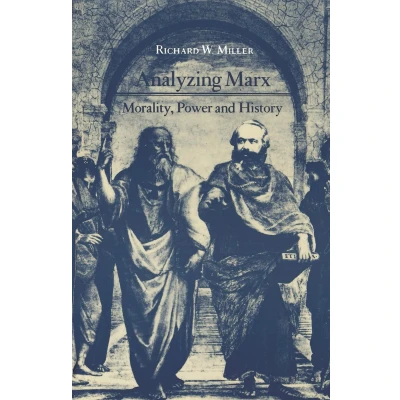
Analyzing Marx: Morality, Power and History
Uitgelicht

|
58,99
56,99 |
Naar shop
|
| VERGELIJK ALLE AANBIEDERS (1) | ||
 Beschrijving
Bol
In this book Marx is revealed as a powerful contributor to the debates that now dominate philosophy and political theory. Using the techniques of analytic philosophy to unite Marx's general statements with his practice as historian and activist, Richard W. Miller derives important arguments about the rational basis of morality, the nature of power, In this book Marx is revealed as a powerful contributor to the debates that now dominate philosophy and political theory. Using the techniques of analytic philosophy to unite Marx's general statements with his practice as historian and activist, Richard W. Miller derives important arguments about the rational basis of morality, the nature of power, and the logic of testing and explanation. The book also makes Marx's theory of change useful for current social science, by replacing economic determinist readings with a new interpretation in which systems of power relations are the basis of change. Part One discusses Marx's criticisms of the moral point of view as a basis for social choice. The outlook that emerges is humane but antimoral. Part Two argues that Marx's concept of the ruling class is a means, of measuring political power that is ignored yet urgently needed by present-day social science. Part Three bases Marx's theory of history on the dynamics of power, challenging both the standard, economic determinist readings of the theory and standard conceptions of science.


Vergelijk aanbieders (1)

 Beschrijving
(1)
Beschrijving
(1)
In this book Marx is revealed as a powerful contributor to the debates that now dominate philosophy and political theory. Using the techniques of analytic philosophy to unite Marx's general statements with his practice as historian and activist, Richard W. Miller derives important arguments about the rational basis of morality, the nature of power, In this book Marx is revealed as a powerful contributor to the debates that now dominate philosophy and political theory. Using the techniques of analytic philosophy to unite Marx's general statements with his practice as historian and activist, Richard W. Miller derives important arguments about the rational basis of morality, the nature of power, and the logic of testing and explanation. The book also makes Marx's theory of change useful for current social science, by replacing economic determinist readings with a new interpretation in which systems of power relations are the basis of change. Part One discusses Marx's criticisms of the moral point of view as a basis for social choice. The outlook that emerges is humane but antimoral. Part Two argues that Marx's concept of the ruling class is a means, of measuring political power that is ignored yet urgently needed by present-day social science. Part Three bases Marx's theory of history on the dynamics of power, challenging both the standard, economic determinist readings of the theory and standard conceptions of science.
 Productspecificaties
| EAN |
|
|---|---|
| Maat |
|
 Prijshistorie
Prijzen voor het laatst bijgewerkt op:
 Gerelateerde resultaten


