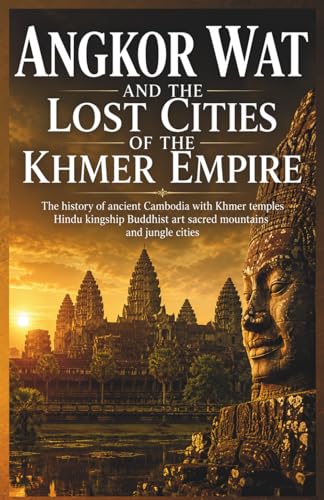
Angkor Wat rises above the Cambodian landscape as one of the most remarkable monuments of the ancient world. Its towers, carved galleries, sacred courtyards, and surrounding jungle preserve the memory of the Khmer Empire, a powerful civilization that transformed mainland Southeast Asia through architecture, religion, water systems, roads, and royal cities. Angkor Wat and the Lost Cities of the Khmer Empire presents the history of ancient Cambodia from the early foundations of Khmer power to the rise of Angkor, the reigns of influential kings, the construction of monumental temples, and the gradual movement of political authority away from the old capital. The story goes far beyond a single temple. It explores Angkor Thom and the stone faces of the Bayon, Ta Prohm and its tree covered ruins, Preah Khan and its sacred courtyards, Koh Ker and its stepped pyramid, Banteay Chhmar and its distant reliefs, and the hidden urban landscapes revealed by modern archaeology. The book also examines the role of Hindu kingship, Buddhist devotion, sacred mountains, reservoirs, canals, royal roads, stone bridges, hospitals, and the communities who lived around the temples. Farmers, artisans, monks, pilgrims, soldiers, and builders all formed part of the human world behind the monuments. Readers will learn how the Khmer Empire expanded, how Angkor survived war and climate pressure, why the royal court moved southward, and how the temples remained connected to Cambodian identity, religious life, and cultural memory. This book is a valuable choice for readers interested in Angkor Wat, ancient Cambodia, Khmer temples, Southeast Asian history, lost cities, archaeology, and the great civilizations of the ancient world.
Prijshistorie
* Prijshistorie bevat geen data van Amazon, Amazon Marketplace.
Prijzen voor het laatst bijgewerkt op: