


gebruikt € 39,03 Gratis verzending

Uitgelicht
|
|
39,03 |
Naar shop
|

|
47,99 |
Naar shop
|
| VERGELIJK ALLE AANBIEDERS (2) | ||
 Beschrijving
Vergelijk aanbieders (2)
gebruikt € 39,03 Gratis verzending
€ 47,99 Gratis verzending
Winkels met andere maten
Beschrijving
(2)
Synchrotron radiation became available in a routine and regular manner to the scientific community in the early 1980s. Synchrotron radiation became available in a routine and regular manner to the scientific community in the early 1980s. Since that time the use of techniques employing synchrotron radiation has proliferated, so that the unique properties of this form ofelectromagnetic radiation are now having a major impact on several areas of physical and biological sciences. Not only have several new techniques become available but new opportunities with existing methodologies, e.g. diffraction, have been opened up. In this book we providea surveyofsomeofthemostimportantapplications ofsynchrotron radiation, with astrongemphasison the fields ofchemistry and materials science. An introduction to the properties of the radiation and its instrumentation is given in chapter 1. The following chapters describe the use ofsynchrotron radiation in high resolution powder diffraction for structural studies of crystalline materials and in diffraction topography for imaging defects in single crystals. The role of EXAFS in investigations of amorphous and disordered crystalline solids and ofbiological systems is highlighted. The important enhancements to surface science techniques offered by synchrotron radiation are then reviewed. Later chapters describe more specialist applic ations, including trace-element analysis, protein crystallography, X-ray microscopy, and atomic and molecular spectroscopy.
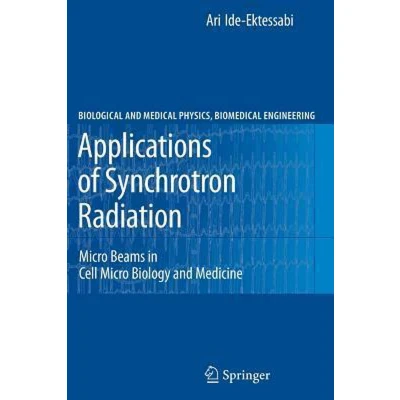
Bol PartnerPhysics and engineering governing the applications of synchrotron radiation is based on enormous achievements during more than one hundred years in the ?led of X-ray physics and technology. This book demonstrates the applications of synchrotron radiation in certain aspects of cell microbiology, specifically non-destructive elemental analyses, chemical-state analyses and imaging (distribution) of the elements within a cell. The basics for understanding and applications of synchrotron radiation are also described to make the contents easier to be understood for a wide group of researchers in medical and biological sciences who might not be familiar with the physics of synchrotron radiation. The two main techniques that are discussed in this book are the x-ray fluorescence spectroscopy (XRF) and the x-ray fine structure analysis (XAFS). Application of these techniques in investigations of several important scientific fields, such as neurodegeneration and other diseases related to cell malfunctioning, are demonstrated in this book.
 Productspecificaties
| EAN |
|
|---|---|
| Maat |
|
 Prijshistorie
Prijzen voor het laatst bijgewerkt op:
 Gerelateerde resultaten


