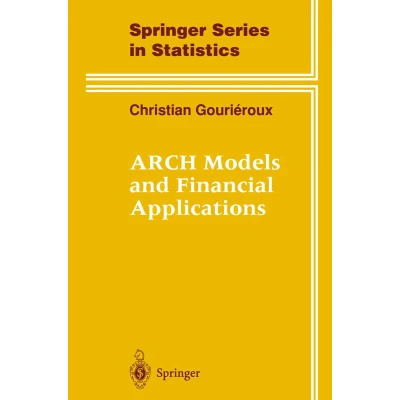



gebruikt € 96,42 Gratis verzending

Uitgelicht
|
|
96,42 |
Naar shop
|

|
119,00 |
Naar shop
|
| VERGELIJK ALLE AANBIEDERS (2) | ||
 Beschrijving
Vergelijk aanbieders (2)
gebruikt € 96,42 Gratis verzending
€ 119,00 Gratis verzending
Winkels met andere maten
Beschrijving
(2)
The ARMA models have limitations when applied to the field of financial and monetary economics. Financial time series present nonlinear dynamic characteristics and ARCH models offer an adaptive framework for this problem. This book surveys the work in this area from the perspective of statistical theory, financial models, and applications. 1.1 The DevelopmentofARCH Models Time series models have been initially introduced either for descriptive purposes like prediction and seasonal correction or for dynamic control. In the 1970s, the researchfocusedonaspecificclassoftimeseriesmodels,theso-calledautoregres- sive moving average processes (ARMA), which were very easy to implement. In thesemodels,thecurrentvalueoftheseriesofinterestiswrittenasalinearfunction ofits own laggedvalues andcurrentandpastvaluesofsomenoiseprocess, which can be interpreted as innovations to the system. However, this approach has two major drawbacks: 1) it is essentially a linear setup, which automatically restricts the type of dynamics to be approximated; 2) it is generally applied without im- posing a priori constraintson the autoregressive and moving average parameters, which is inadequatefor structural interpretations. Among the field ofapplications where standard ARMA fit is poorare financial and monetary problems. The financial time series features various forms ofnon- lineardynamics,the crucialone being the strongdependenceofthe instantaneous variabilityoftheseriesonitsownpast. Moreover,financial theoriesbasedoncon- ceptslikeequilibriumorrationalbehavioroftheinvestorswouldnaturallysuggest including and testing some structural constraints on the parameters. In this con- text, ARCH (Autoregressive Conditionally Heteroscedastic) models, introduced by Engle (1982), arise as an appropriate framework for studying these problems. Currently, there existmorethan onehundredpapers and some dozenPh.D. theses on this topic, which reflects the importance ofthis approach for statistical theory, finance and empirical work. 2 1. Introduction From the viewpoint ofstatistical theory, the ARCH models may be considered as some specific nonlinear time series models, which allow for aquite exhaustive studyoftheunderlyingdynamics.Itisthereforepossibletoreexamineanumberof classicalquestions like the random walkhypothesis, prediction intervals building, presenceoflatentvariables [factors] etc., and to test the validity ofthe previously established results.
Bol1.1 The DevelopmentofARCH Models Time series models have been initially introduced either for descriptive purposes like prediction and seasonal correction or for dynamic control. In the 1970s, the researchfocusedonaspecificclassoftimeseriesmodels,theso-calledautoregres- sive moving average processes (ARMA), which were very easy to implement. In thesemodels,thecurrentvalueoftheseriesofinterestiswrittenasalinearfunction ofits own laggedvalues andcurrentandpastvaluesofsomenoiseprocess, which can be interpreted as innovations to the system. However, this approach has two major drawbacks: 1) it is essentially a linear setup, which automatically restricts the type of dynamics to be approximated; 2) it is generally applied without im- posing a priori constraintson the autoregressive and moving average parameters, which is inadequatefor structural interpretations. Among the field ofapplications where standard ARMA fit is poorare financial and monetary problems. The financial time series features various forms ofnon- lineardynamics,the crucialone being the strongdependenceofthe instantaneous variabilityoftheseriesonitsownpast. Moreover,financial theoriesbasedoncon- ceptslikeequilibriumorrationalbehavioroftheinvestorswouldnaturallysuggest including and testing some structural constraints on the parameters. In this con- text, ARCH (Autoregressive Conditionally Heteroscedastic) models, introduced by Engle (1982), arise as an appropriate framework for studying these problems. Currently, there existmorethan onehundredpapers and some dozenPh.D. theses on this topic, which reflects the importance ofthis approach for statistical theory, finance and empirical work. 2 1. Introduction From the viewpoint ofstatistical theory, the ARCH models may be considered as some specific nonlinear time series models, which allow for aquite exhaustive studyoftheunderlyingdynamics.Itisthereforepossibletoreexamineanumberof classicalquestions like the random walkhypothesis, prediction intervals building, presenceoflatentvariables [factors] etc., and to test the validity ofthe previously established results.
 Productspecificaties
| EAN |
|
|---|---|
| Maat |
|
 Prijshistorie
Prijzen voor het laatst bijgewerkt op:
 Gerelateerde resultaten


