
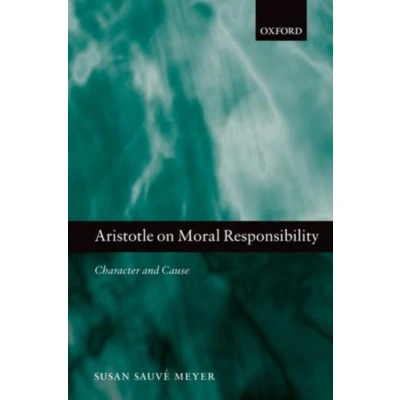
Aristotle on Moral Responsibility
Uitgelicht

|
45,00 |
Naar shop
|

|
51,99 |
Naar shop
|
| VERGELIJK ALLE AANBIEDERS (2) | ||
 Beschrijving
Bol
This is a reissue, with new introduction, of Susan Sauvé Meyer's 1993 book which presents a striking interpretation of Aristotle's accounts of voluntariness in the Eudemian and Nicomachean Ethics. She argues that they constitute a distinctive theory of moral responsibility, and provides powerful responses to notorious puzzles in the account. This is a reissue, with new introduction, of Susan Sauvé Meyer's 1993 book, in which she presents a comprehensive examination of Aristotle's accounts of voluntariness in the Eudemian and Nicomachean Ethics. She makes the case that these constitute a theory of moral responsibility--albeit one with important differences from modern theories. Highlights of the discussion include a reconstruction of the dialectical argument in the Eudemian Ethics II 6-9, and a demonstration that the definitions of 'voluntary' and 'involuntary' in Nicomachean Ethics III 1 are the culmination of that argument. By identifying the paradigms of voluntariness and involuntariness that Aristotle begins with and the opponents (most notably Plato) he addresses, Meyer explains notoriously puzzling features of the Nicomachean account--such as Aristotle's requirement that involuntary agents experience pain or regret. Other familiar features of Aristotle's account are cast in a new light. That we are responsible for the characters we develop turns out not to be a necessary condition of responsible agency. That voluntary action has its "origin" in the agent and that our actions are "up to us to do and not to do"--often interpreted as implying a libertarian conception of agency--turn out to be perfectly compatible with causal determinism, a point Meyer makes by locating these locutions in the context of Aristotle's general understanding of causality. While Aristotle does not himself face or address worries that determinism is incompatible with responsibility, his causal repertoire provides the resources for a powerful response to incompatibilist arguments. On this and other fronts Aristotle's is a view to be taken seriously by theorists of moral responsibility.


 Beschrijving
(2)
Beschrijving
(2)
This is a reissue, with new introduction, of Susan Sauvé Meyer's 1993 book which presents a striking interpretation of Aristotle's accounts of voluntariness in the Eudemian and Nicomachean Ethics. She argues that they constitute a distinctive theory of moral responsibility, and provides powerful responses to notorious puzzles in the account. This is a reissue, with new introduction, of Susan Sauvé Meyer's 1993 book, in which she presents a comprehensive examination of Aristotle's accounts of voluntariness in the Eudemian and Nicomachean Ethics. She makes the case that these constitute a theory of moral responsibility--albeit one with important differences from modern theories. Highlights of the discussion include a reconstruction of the dialectical argument in the Eudemian Ethics II 6-9, and a demonstration that the definitions of 'voluntary' and 'involuntary' in Nicomachean Ethics III 1 are the culmination of that argument. By identifying the paradigms of voluntariness and involuntariness that Aristotle begins with and the opponents (most notably Plato) he addresses, Meyer explains notoriously puzzling features of the Nicomachean account--such as Aristotle's requirement that involuntary agents experience pain or regret. Other familiar features of Aristotle's account are cast in a new light. That we are responsible for the characters we develop turns out not to be a necessary condition of responsible agency. That voluntary action has its "origin" in the agent and that our actions are "up to us to do and not to do"--often interpreted as implying a libertarian conception of agency--turn out to be perfectly compatible with causal determinism, a point Meyer makes by locating these locutions in the context of Aristotle's general understanding of causality. While Aristotle does not himself face or address worries that determinism is incompatible with responsibility, his causal repertoire provides the resources for a powerful response to incompatibilist arguments. On this and other fronts Aristotle's is a view to be taken seriously by theorists of moral responsibility.
Bol PartnerWhat makes an agent properly subject to moral expectations and evaluations? Why do they merit praise or blame for particular things they do? This important new book illuminates for the first time Aristotle's response to these central questions of ethics.The author shows that, contrary to those who think ''moral responsibility'' is a peculiarly modern notion, Aristotle's discussions of character and voluntariness address issues vital to the theory of moral responsibility. On this view, Aristotle develops a sophisticated theory capable of solving most of the problems any approach to moral responsibility must address. Meyer explains how this theory differs from many modern accounts: it holds that responsibility for character is not necessary for moral responsibility, and while it does not require that moral agency be an exception to the type of causation operating elsewhere, it is not vulnerable, she argues, to familiar anti-naturalist and incompatabilist criticisms. The causal notions to which Aristotle appeals allow him to articulate and defend the special causal status we assign to the moral agent without locating such agency outside the natural world.
 Productspecificaties
| EAN |
|
|---|---|
| Maat |
|
 Prijshistorie
Prijzen voor het laatst bijgewerkt op:
 Gerelateerde resultaten


