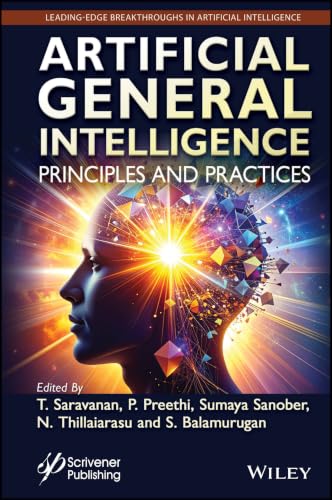
Artificial General Intelligence: Principles and Practices

Prijzen vanaf
192,00

Uitgelicht

VERGELIJK ALLE AANBIEDERS (3)

Beschrijving

Bol This comprehensive guide provides an extensive overview of the key theories, methodologies, and applied frameworks that enable AGI systems to exhibit aspects of human intelligence. As the role of artificial intelligence grows in our everyday lives, so does the need for AI with greater capabilities. Unlike narrow AI, confined to specific tasks, artificial general intelligence seeks human-like adaptability, reasoning, and learning across domains. Integrating cognitive, mathematical, and computational concepts, it presents multidimensional solutions to create more natural human-AI interactions. This book examines the theoretical foundations, cognitive architectures, and practical methodologies shaping artificial general intelligence. It highlights the significance of human-like emotional intelligence in AI and its potential to create more natural, empathetic, and intuitive human-AI interactions, using techniques such as facial expression analysis, speech emotion recognition, and physiological signal processing. From healthcare to customer service, affective AI is being used to enhance user experiences by tailoring interactions to the emotional states of individuals. The book also discusses the ethical dilemmas posed by affective AI, such as emotional manipulation, bias in emotion detection, and the impact of AI-driven emotional decisions on human behavior. Balancing rigor with practical insight, the volume provides a roadmap for researchers, practitioners, and policymakers to study artificial general intelligence’s evolution and transformative potential. Readers will find the volume: Discusses different applications of affective artificial intelligence across various industries; Introduces the fundamental concepts of reinforcement learning for different applications; Presents the state-of-the-art of transfer learning analysis through contributions from industry and academia. Audience Engineering research scholars, students, IT professionals, network administrators, artificial intelligence and deep learning experts, and government research agencies. This comprehensive guide provides an extensive overview of the key theories, methodologies, and applied frameworks that enable AGI systems to exhibit aspects of human intelligence. As the role of artificial intelligence grows in our everyday lives, so does the need for AI with greater capabilities. Unlike narrow AI, confined to specific tasks, artificial general intelligence seeks human-like adaptability, reasoning, and learning across domains. Integrating cognitive, mathematical, and computational concepts, it presents multidimensional solutions to create more natural human-AI interactions. This book examines the theoretical foundations, cognitive architectures, and practical methodologies shaping artificial general intelligence. It highlights the significance of human-like emotional intelligence in AI and its potential to create more natural, empathetic, and intuitive human-AI interactions, using techniques such as facial expression analysis, speech emotion recognition, and physiological signal processing. From healthcare to customer service, affective AI is being used to enhance user experiences by tailoring interactions to the emotional states of individuals. The book also discusses the ethical dilemmas posed by affective AI, such as emotional manipulation, bias in emotion detection, and the impact of AI-driven emotional decisions on human behavior. Balancing rigor with practical insight, the volume provides a roadmap for researchers, practitioners, and policymakers to study artificial general intelligence’s evolution and transformative potential. Readers will find the volume: Discusses different applications of affective artificial intelligence across various industries; Introduces the fundamental concepts of reinforcement learning for different applications; Presents the state-of-the-art of transfer learning analysis through contributions from industry and academia. Audience Engineering research scholars, students, IT professionals, network administrators, artificial intelligence and deep learning experts, and government research agencies.

Vergelijk aanbieders (3)

Shop
Prijs
Verzendkosten
Totale prijs
192,00
Gratis
192,00
Naar shop
Gratis Shipping Costs
192,00
Gratis
192,00
Naar shop
Gratis Shipping Costs
195,00
Gratis
195,00
Naar shop
Gratis Shipping Costs
Beschrijving (2)
Bol

This comprehensive guide provides an extensive overview of the key theories, methodologies, and applied frameworks that enable AGI systems to exhibit aspects of human intelligence. As the role of artificial intelligence grows in our everyday lives, so does the need for AI with greater capabilities. Unlike narrow AI, confined to specific tasks, artificial general intelligence seeks human-like adaptability, reasoning, and learning across domains. Integrating cognitive, mathematical, and computational concepts, it presents multidimensional solutions to create more natural human-AI interactions. This book examines the theoretical foundations, cognitive architectures, and practical methodologies shaping artificial general intelligence. It highlights the significance of human-like emotional intelligence in AI and its potential to create more natural, empathetic, and intuitive human-AI interactions, using techniques such as facial expression analysis, speech emotion recognition, and physiological signal processing. From healthcare to customer service, affective AI is being used to enhance user experiences by tailoring interactions to the emotional states of individuals. The book also discusses the ethical dilemmas posed by affective AI, such as emotional manipulation, bias in emotion detection, and the impact of AI-driven emotional decisions on human behavior. Balancing rigor with practical insight, the volume provides a roadmap for researchers, practitioners, and policymakers to study artificial general intelligence’s evolution and transformative potential. Readers will find the volume: Discusses different applications of affective artificial intelligence across various industries; Introduces the fundamental concepts of reinforcement learning for different applications; Presents the state-of-the-art of transfer learning analysis through contributions from industry and academia. Audience Engineering research scholars, students, IT professionals, network administrators, artificial intelligence and deep learning experts, and government research agencies. This comprehensive guide provides an extensive overview of the key theories, methodologies, and applied frameworks that enable AGI systems to exhibit aspects of human intelligence. As the role of artificial intelligence grows in our everyday lives, so does the need for AI with greater capabilities. Unlike narrow AI, confined to specific tasks, artificial general intelligence seeks human-like adaptability, reasoning, and learning across domains. Integrating cognitive, mathematical, and computational concepts, it presents multidimensional solutions to create more natural human-AI interactions. This book examines the theoretical foundations, cognitive architectures, and practical methodologies shaping artificial general intelligence. It highlights the significance of human-like emotional intelligence in AI and its potential to create more natural, empathetic, and intuitive human-AI interactions, using techniques such as facial expression analysis, speech emotion recognition, and physiological signal processing. From healthcare to customer service, affective AI is being used to enhance user experiences by tailoring interactions to the emotional states of individuals. The book also discusses the ethical dilemmas posed by affective AI, such as emotional manipulation, bias in emotion detection, and the impact of AI-driven emotional decisions on human behavior. Balancing rigor with practical insight, the volume provides a roadmap for researchers, practitioners, and policymakers to study artificial general intelligence’s evolution and transformative potential. Readers will find the volume: Discusses different applications of affective artificial intelligence across various industries; Introduces the fundamental concepts of reinforcement learning for different applications; Presents the state-of-the-art of transfer learning analysis through contributions from industry and academia. Audience Engineering research scholars, students, IT professionals, network administrators, artificial intelligence and deep learning experts, and government research agencies.

Amazon

Pagina's: 480, Editie: Eerste editie, Hardcover, Wiley-Scrivener


Productspecificaties

Merk Wiley
EAN
  • 9781394422678
Maat


Prijshistorie

* Prijshistorie bevat geen data van Amazon, Amazon Marketplace.

Prijzen voor het laatst bijgewerkt op:

Uitgelichte Keuze
192,00
Naar shop
