

€ 9,24 Gratis verzending

Uitgelicht
|
|
9,24 |
Naar shop
|

|
9,24 |
Naar shop
|

|
10,50 |
Naar shop
|
| VERGELIJK ALLE AANBIEDERS (3) | ||
 Beschrijving
Vergelijk aanbieders (3)
€ 9,24 Gratis verzending
€ 9,24 Gratis verzending
€ 10,50 € 2,99 verzendkosten Totaal € 13,49
Winkels met andere maten
Beschrijving
(1)
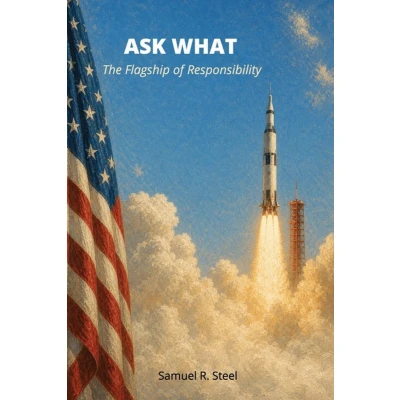
In 1961, John F. Kennedy delivered a thirteen-hundred-word address that most Americans have never read. They know one sentence. They have forgotten - or never knew - what the sentence was asking. Ask What: The Flagship of Responsibility is an attempt to restore the full weight of that asking. Kennedy's inaugural address is not primarily a piece of political history. Read carefully, as a unit rather than quarried for quotable lines, it describes something very close to a complete theory of civic adulthood - a progression from dependence through contribution through interdependence to stewardship. Ask What takes that progression seriously as a practical framework for how to live. The book is organized around four parts that follow Kennedy's own structure. - Part I examines where the sentence came from and whether it is serious - the drafting, the compression, the specific rhetorical engineering that made fourteen words load-bearing across six decades.- Part II asks what answering the sentence looks like in practice: in workshops and repair cafés, in classrooms and GI Bill trade schools, in the structures that determine whether ordinary people have a shot at contributing.- Part III examines the tests that civic adulthood faces - courage, protection, accountability, and the unglamorous work of keeping communities from splitting apart.- Part IV extends the frame: to the moon program as a model of intergenerational investment, to the Cuban Missile Crisis as a case study in cooperative design, to the daily maintenance of freedoms that fail not with a bang but through accumulated small neglects. This is not a book about politics. It does not argue for a party or a platform. The Civic Adulthood Ladder is not left or right. It is the precondition for political freedom regardless of what you do with that freedom. Alexis de Tocqueville worried, in 1840, that democratic citizens would gradually trade active citizenship for passive comfort - that they would consent to be managed rather than governed, entertained rather than engaged. Kennedy's sentence was a direct counter to that. Ask What is an argument that the counter still works, and a guide to running it.
 Prijshistorie
 * Prijshistorie bevat geen data van Amazon, Amazon Marketplace.
Prijzen voor het laatst bijgewerkt op:
 Gerelateerde resultaten
 Productspecificaties


