

€ 33,37 Gratis verzending

Uitgelicht
|
|
33,37 |
Naar shop
|

|
33,37 |
Naar shop
|

|
34,99 |
Naar shop
|
| VERGELIJK ALLE AANBIEDERS (3) | ||
 Beschrijving
Vergelijk aanbieders (3)
€ 33,37 Gratis verzending
€ 33,37 Gratis verzending
€ 34,99 Gratis verzending
Winkels met andere maten
Beschrijving
(1)
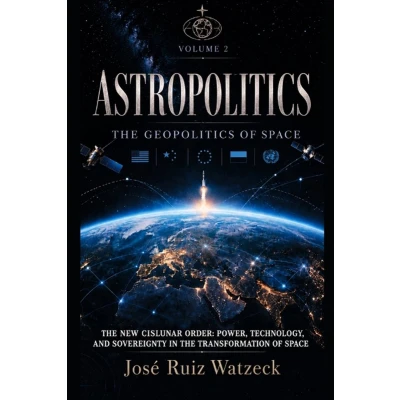
Outer space has lost its status as a neutral domain. Beneath the terrestrial vault, a new architecture of power and governance is taking shape: satellites redefine global surveillance, megaconstellations organize information flows, private corporations assume state prerogatives, and military powers develop capabilities to safeguard-or disable-orbital assets. Concurrently, the Moon ceases to be a mere scientific destination, transforming into a fundamental logistical, economic, and strategic vector.This transformation reconfigures the systemic balance of the 21st century. Technological competition between the United States and China intensifies, while new state and corporate actors vie for hegemony in the extra-atmospheric realm. More than a fleeting destination, space is consolidating as an environment of permanent presence, where orbital servicing, cislunar mining, and infrastructure automation create the material preconditions for civilizational continuity beyond Earth.However, this expansion replicates terrestrial historical rivalries in the cosmos. Control over orbital corridors, normative standardization, and the appropriation of cislunar resources are becoming new axes of geopolitical friction.In Astropolitics - The Geopolitics of Space - Volume II - The New Cislunar Order: Power, Technology, and Sovereignty in the Transformation of Space, José Ruiz Watzeck offers a rigorous, interdisciplinary analysis of this metamorphosis. The work examines the militarization of orbits, the proliferation of anti-satellite (ASAT) weapons, debris management, and the structuring of the space economy, grounding its reflection on an unprecedented conceptual framework: - Astropolitical Cadence- Orbital Connective Sovereignty- Economy of Orbital Continuity- Systemic Orbital Pressure- Intergenerational Orbital Debt- Extraterrestrial Material Sovereignty- Astropolitical Depth- Civilizational Permanence ThresholdThese categories demonstrate that the decisive vector of the new space age lies not in the capacity for episodic projection (arriving), but in the strategic aptitude for sustainability (remaining). While missions generate prestige, it is infrastructure that organizes power. The central question of contemporary International Relations is no longer whether space expansion will occur, but who will hold the normative and material authority to dictate the rules of this new order.
 Prijshistorie
 * Prijshistorie bevat geen data van Amazon, Amazon Marketplace.
Prijzen voor het laatst bijgewerkt op:
 Gerelateerde resultaten
 Productspecificaties


