


€ 17,60 € 2,99 verzendkosten Totaal € 20,59

Uitgelicht
|
|
17,60 |
Naar shop
|

|
18,33 |
Naar shop
|

|
18,33 |
Naar shop
|
| VERGELIJK ALLE AANBIEDERS (3) | ||
 Beschrijving
Vergelijk aanbieders (3)
€ 17,60 € 2,99 verzendkosten Totaal € 20,59
€ 18,33 Gratis verzending
€ 18,33 Gratis verzending
Winkels met andere maten
Beschrijving
(1)
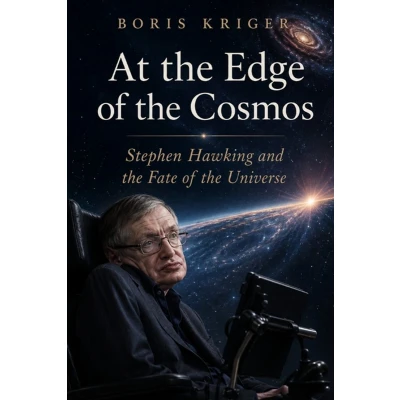
Stephen Hawking gave the twentieth century its most famous picture of the universe: a cosmos with no edge, no first moment, no place where the laws break down. It was beautiful. It was also, quietly, a decision rather than a discovery. At the Edge of the Cosmos follows one reader's forty-year argument with that picture. The book begins at a secondhand book stall in London in the mid-nineties, where a man in his late twenties bought a well-thumbed copy of A Brief History of Time, found most of it familiar, and then reached the final chapter and could not put it down. It ends in the present, with an unanswered email to the astronomer who found a ring of galaxies four billion light-years across, and with a simple request that nobody has yet troubled to fulfill: look at the opposite side of the sky. In between comes a serious, affectionate, and thoroughly unintimidated examination of everything Hawking actually achieved - the singularity theorems, the area theorem, the four laws of black hole mechanics, the radiation that carries his name, the information paradox he created and then conceded, the no-boundary proposal, the chronology protection conjecture - and a careful accounting of which of those results were measured, which were derived, and which were simply declared and then repeated until they sounded measured. The distinction turns out to matter enormously. Hawking himself was scrupulous about it. His readers were not. Along the way the book takes up the alternatives: collapse that halts at a finite density set by nuclear physics rather than running away to a singularity; black holes as archives rather than shredders; a universe rounded off by the elastic limit of spacetime rather than by a mathematical convenience; and time understood not as a river but as the set of conditions under which a thing can continue to exist. It also considers the men at the far end of the argument - Roger Penrose, with his circles in the microwave sky, and Julian Barbour, who spent a career proving that time does not exist and then, at eighty-eight, gave the universe back its first instant. This is not a debunking. Hawking was right about a great deal, and the book says so at length. It is something rarer: a genuine dispute, conducted on the merits, by someone who has spent three decades in the same territory and is still arguing with the book that sent him there. Keywords: Cosmology, black holes, Stephen Hawking, scientific method, philosophy of science, the origin of the universe, dark energy
 Prijshistorie
 * Prijshistorie bevat geen data van Amazon, Amazon Marketplace.
Prijzen voor het laatst bijgewerkt op:
 Gerelateerde resultaten
 Productspecificaties


