
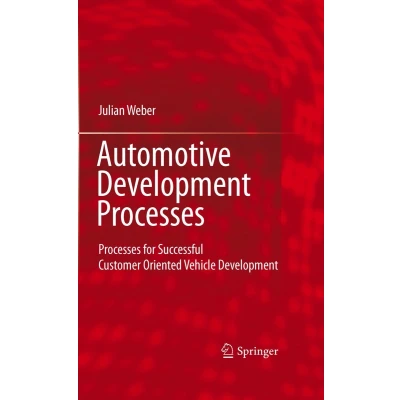
Automotive Development Processes
Uitgelicht

|
184,00 |
Naar shop
|
| VERGELIJK ALLE AANBIEDERS (1) | ||
 Beschrijving
Bol
This comprehensive, practical text discusses the critical factors for success in automotive development, from product strategy through all phases of development to series production. It characterizes the roles and activities of each phase. For any product development process, the key question is which factors guarantee the product’s success in the market. The book discusses the critical factors for success in automotive development, from product strategy through all phases of development to series production, and characterizes the roles and activities of all partners involved. It is a comprehensive, practically oriented compilation of motor vehicle development, focusing on the complete vehicle integration processes as the orchestration of all activities required to strategically plan and implement the customer relevant characteristics of the complete product. The book covers central subjects such as building and testing of virtual cars, systems integration, project management or supplier integration; and offers a variety of examples and pictures from real-life vehicle development and gives the reader a very realistic insight into the complex world of vehicle development projects. The global crisis the automotive industry has slipped into over the second half of 2008 has set a fierce spotlight not only on which cars are the right ones to bring to the market but also on how these cars are developed. Be it OEMs developing new models, suppliers integerating themselves deeper into the development processes of different OEMs, analysts estimating economical risks and opportunities of automotive investments, or even governments creating and evaluating scenarios for financial aid for suffering automotive companies: At the end of the day, it is absolutely indispensable to comprehensively understand the processes of auto- tive development – the core subject of this book. Let’s face it: More than a century after Carl Benz, Wilhelm Maybach and Gottlieb Daimler developed and produced their first motor vehicles, the overall concept of passenger cars has not changed much. Even though components have been considerably optimized since then, motor cars in the 21st century are still driven by combustion engines that transmit their propulsive power to the road s- face via gearboxes, transmission shafts and wheels, which together with spri- damper units allow driving stability and ride comfort. Vehicles are still navigated by means of a steering wheel that turns the front wheels, and the required control elements are still located on a dashboard in front of the driver who operates the car sitting in a seat.


Vergelijk aanbieders (1)

 Beschrijving
(1)
Beschrijving
(1)
This comprehensive, practical text discusses the critical factors for success in automotive development, from product strategy through all phases of development to series production. It characterizes the roles and activities of each phase. For any product development process, the key question is which factors guarantee the product’s success in the market. The book discusses the critical factors for success in automotive development, from product strategy through all phases of development to series production, and characterizes the roles and activities of all partners involved. It is a comprehensive, practically oriented compilation of motor vehicle development, focusing on the complete vehicle integration processes as the orchestration of all activities required to strategically plan and implement the customer relevant characteristics of the complete product. The book covers central subjects such as building and testing of virtual cars, systems integration, project management or supplier integration; and offers a variety of examples and pictures from real-life vehicle development and gives the reader a very realistic insight into the complex world of vehicle development projects. The global crisis the automotive industry has slipped into over the second half of 2008 has set a fierce spotlight not only on which cars are the right ones to bring to the market but also on how these cars are developed. Be it OEMs developing new models, suppliers integerating themselves deeper into the development processes of different OEMs, analysts estimating economical risks and opportunities of automotive investments, or even governments creating and evaluating scenarios for financial aid for suffering automotive companies: At the end of the day, it is absolutely indispensable to comprehensively understand the processes of auto- tive development – the core subject of this book. Let’s face it: More than a century after Carl Benz, Wilhelm Maybach and Gottlieb Daimler developed and produced their first motor vehicles, the overall concept of passenger cars has not changed much. Even though components have been considerably optimized since then, motor cars in the 21st century are still driven by combustion engines that transmit their propulsive power to the road s- face via gearboxes, transmission shafts and wheels, which together with spri- damper units allow driving stability and ride comfort. Vehicles are still navigated by means of a steering wheel that turns the front wheels, and the required control elements are still located on a dashboard in front of the driver who operates the car sitting in a seat.
 Productspecificaties
| EAN |
|
|---|---|
| Maat |
|
 Prijshistorie
Prijzen voor het laatst bijgewerkt op:
 Gerelateerde resultaten


