
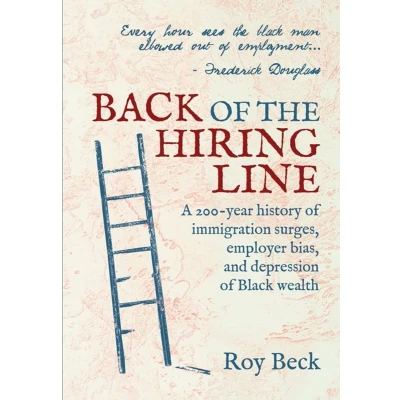
Back of the Hiring Line: A 200-Year History Immigration Surges, Employer Bias, and Depression Black Wealth
Uitgelicht

|
24,93 |
Naar shop
|

|
63,29 |
Naar shop
|

|
63,29 |
Naar shop
|
| VERGELIJK ALLE AANBIEDERS (3) | ||
 Beschrijving
Bol
For a half-century after the Civil War, nearly all emancipated slaves and descendants remained in the land of their enslavement. Why didn't they leave?How did the German submarines of World War One help kick off the greatest period of Black economic success and a track to civil rights?Why during six decades under 1960s civil rights laws and programs have Black employment and economic equality stagnated and regressed?Here is a grand sweep of the missing stories that help explain perplexing puzzles of Black history. Back Of the Hiring Line solidifies the author's reputation for a gentle style that is "always balanced and never strident" (Washington Post), "fosters serious debate" (New York Times), and "marshals the evidence ... as persuasively as anyone" (Foreign Affairs), according to reviewers of his previous work.". . . artful story-telling in an extensive, well-documented, and powerful indictment of our governmental and societal failure to protect fundamental national interests involving Black Americans." --Jerry Kammer, Pulitzer-honored investigative journalist, author of Losing ControlPioneering Black editors and orators drive the narrative of how eras of sustained mass immigration have always stalled descendants of American slavery in their climbs up employment ladders.In their own words, they describe how excess foreign labor in the North and West first blocked former slaves from fleeing life under intimidating and often violent Black codes and, periodically ever since, has restrained Black workers' attempts to obtain jobs in emerging industries, to develop career networking, and to build transferable assets.The book shows how the practical effect of these mass-immigration eras has been to steal Black wealth before it could even be earned.Back of the Hiring Line pulls together this wrenching history through first-hand reporting, forgotten records, and neglected results of major past investigations. And it delves into the wisdom of historic Black leaders such as Frederick Douglass, Booker T. Washington, W.E.B. DuBois, A. Philip Randolph, and Barbara Jordan as they sought tight-labor, federal immigration policies that best served the interests of the descendants of slavery, as well as all other struggling members of their national community.Amidst growing concerns about the nation's economic inequality, Back of the Hiring Line is a unique contribution among the many books that search for understanding and solutions. It is a long-overdue accounting of America's deep economic divide.


 Beschrijving
(1)
Beschrijving
(1)
For a half-century after the Civil War, nearly all emancipated slaves and descendants remained in the land of their enslavement. Why didn't they leave?How did the German submarines of World War One help kick off the greatest period of Black economic success and a track to civil rights?Why during six decades under 1960s civil rights laws and programs have Black employment and economic equality stagnated and regressed?Here is a grand sweep of the missing stories that help explain perplexing puzzles of Black history. Back Of the Hiring Line solidifies the author's reputation for a gentle style that is "always balanced and never strident" (Washington Post), "fosters serious debate" (New York Times), and "marshals the evidence ... as persuasively as anyone" (Foreign Affairs), according to reviewers of his previous work.". . . artful story-telling in an extensive, well-documented, and powerful indictment of our governmental and societal failure to protect fundamental national interests involving Black Americans." --Jerry Kammer, Pulitzer-honored investigative journalist, author of Losing ControlPioneering Black editors and orators drive the narrative of how eras of sustained mass immigration have always stalled descendants of American slavery in their climbs up employment ladders.In their own words, they describe how excess foreign labor in the North and West first blocked former slaves from fleeing life under intimidating and often violent Black codes and, periodically ever since, has restrained Black workers' attempts to obtain jobs in emerging industries, to develop career networking, and to build transferable assets.The book shows how the practical effect of these mass-immigration eras has been to steal Black wealth before it could even be earned.Back of the Hiring Line pulls together this wrenching history through first-hand reporting, forgotten records, and neglected results of major past investigations. And it delves into the wisdom of historic Black leaders such as Frederick Douglass, Booker T. Washington, W.E.B. DuBois, A. Philip Randolph, and Barbara Jordan as they sought tight-labor, federal immigration policies that best served the interests of the descendants of slavery, as well as all other struggling members of their national community.Amidst growing concerns about the nation's economic inequality, Back of the Hiring Line is a unique contribution among the many books that search for understanding and solutions. It is a long-overdue accounting of America's deep economic divide.
 Productspecificaties
 Prijshistorie
* Prijshistorie bevat geen data van Amazon, Amazon Marketplace.
Prijzen voor het laatst bijgewerkt op:
 Gerelateerde resultaten


