
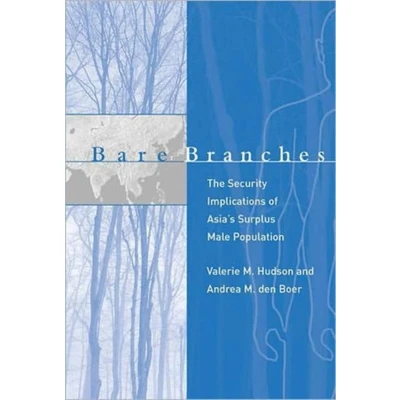
Bare Branches
Uitgelicht

|
31,22 |
Naar shop
|
| VERGELIJK ALLE AANBIEDERS (1) | ||
 Beschrijving
Bol Partner
What happens to a society that has too many men? In this provocative book, Valerie Hudson and Andrea den Boer argue that, historically, high male-to-female ratios often trigger domestic and international violence. Most violent crime is committed by young unmarried males who lack stable social bonds. Although there is not always a direct cause-and-effect relationship, these surplus men often play a crucial role in making violence prevalent within society. Governments sometimes respond to this problem by enlisting young surplus males in military campaigns and high-risk public works projects. Countries with high male-to-female ratios also tend to develop authoritarian political systems. Hudson and den Boer suggest that the sex ratios of many Asian countries, particularly China and India-which represent almost 40 percent of the world's population-are being skewed in favor of males on a scale that may be unprecedented in human history. Through offspring sex selection (often in the form of sex-selective abortion and female infanticide), these countries are acquiring a disproportionate number of low-status young adult males, called bare branches by the Chinese. Hudson and den Boer argue that this surplus male population in Asia's largest countries threatens domestic stability and international security. The prospects for peace and democracy are dimmed by the growth of bare branches in China and India, and, they maintain, the sex ratios of these countries will have global implications in the twenty-first century.


Vergelijk aanbieders (1)

 Beschrijving
(1)
Beschrijving
(1)
What happens to a society that has too many men? In this provocative book, Valerie Hudson and Andrea den Boer argue that, historically, high male-to-female ratios often trigger domestic and international violence. Most violent crime is committed by young unmarried males who lack stable social bonds. Although there is not always a direct cause-and-effect relationship, these surplus men often play a crucial role in making violence prevalent within society. Governments sometimes respond to this problem by enlisting young surplus males in military campaigns and high-risk public works projects. Countries with high male-to-female ratios also tend to develop authoritarian political systems. Hudson and den Boer suggest that the sex ratios of many Asian countries, particularly China and India-which represent almost 40 percent of the world's population-are being skewed in favor of males on a scale that may be unprecedented in human history. Through offspring sex selection (often in the form of sex-selective abortion and female infanticide), these countries are acquiring a disproportionate number of low-status young adult males, called bare branches by the Chinese. Hudson and den Boer argue that this surplus male population in Asia's largest countries threatens domestic stability and international security. The prospects for peace and democracy are dimmed by the growth of bare branches in China and India, and, they maintain, the sex ratios of these countries will have global implications in the twenty-first century.
 Productspecificaties
| EAN |
|
|---|---|
| Maat |
|
 Prijshistorie
Prijzen voor het laatst bijgewerkt op:
 Gerelateerde resultaten


