
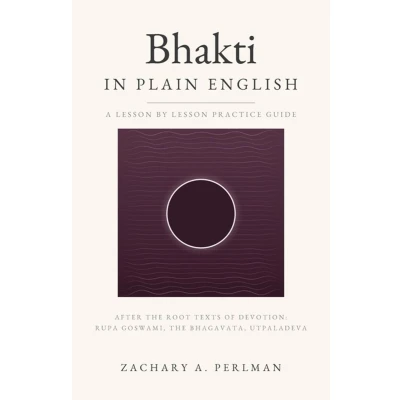
Bhakti In Plain English: A Beginner's Guide To Nondual Devotion And The Nine Stages Of Love
Uitgelicht

|
17,00 |
Naar shop
|

|
41,35 |
Naar shop
|

|
41,35 |
Naar shop
|
| VERGELIJK ALLE AANBIEDERS (3) | ||
 Beschrijving
Bol
Most people who take nonduality seriously have already decided devotion is not for them. They came to this material to stop believing things. But nothing on this path requires you to believe in a god. The tradition presented here holds that the worship, the one worshipping, and the one worshipped are a single thing. It asks only that you have a direction, which you already do, and that you aim it deliberately.Every other contemplative method turns you inward: steady the mind and look at it, ask what you are and follow the question. This one turns you toward. That single difference changes what a session feels like, who can sustain one, and what happens on the days your inner life is not cooperating.And it has a map. Rupa Goswami's sixteenth-century Bhakti-rasamrita-sindhu lays out nine stages, from the first willingness to test something through to the end, each with a name, an account of what it feels like from inside, and an honest estimate of how long it takes. Two of them appear in no other contemplative literature in English:The long flat stretch where nothing happens. Most people who quit a practice quit here, believing they have found something out. They have not. They are standing exactly where the map says they should be.The day the practice stops requiring a decision. Not winning the argument about whether to sit. The argument no longer convening.The practice itself is nine ordinary actions: hearing, naming, remembering, serving, offering, bowing, obeying, befriending, and giving yourself away. They have no order, you are not asked to run all of them, and the whole list fits on an index card.Twenty lessons across six modules, in ordinary English, each with a guided practice or a set of contemplation questions. What faith actually names, and why it is the first rung rather than the entry fee. How to choose a form you do not believe in, and why the tradition's own word for it is the chosen one. Why tears are not evidence, and what the classical marks are instead. What surrender hands over, which is neither the outcome nor the worry. And what happens when you go looking for the one who was doing all of it and cannot find him anywhere.


 Beschrijving
(1)
Beschrijving
(1)
Most people who take nonduality seriously have already decided devotion is not for them. They came to this material to stop believing things. But nothing on this path requires you to believe in a god. The tradition presented here holds that the worship, the one worshipping, and the one worshipped are a single thing. It asks only that you have a direction, which you already do, and that you aim it deliberately.Every other contemplative method turns you inward: steady the mind and look at it, ask what you are and follow the question. This one turns you toward. That single difference changes what a session feels like, who can sustain one, and what happens on the days your inner life is not cooperating.And it has a map. Rupa Goswami's sixteenth-century Bhakti-rasamrita-sindhu lays out nine stages, from the first willingness to test something through to the end, each with a name, an account of what it feels like from inside, and an honest estimate of how long it takes. Two of them appear in no other contemplative literature in English:The long flat stretch where nothing happens. Most people who quit a practice quit here, believing they have found something out. They have not. They are standing exactly where the map says they should be.The day the practice stops requiring a decision. Not winning the argument about whether to sit. The argument no longer convening.The practice itself is nine ordinary actions: hearing, naming, remembering, serving, offering, bowing, obeying, befriending, and giving yourself away. They have no order, you are not asked to run all of them, and the whole list fits on an index card.Twenty lessons across six modules, in ordinary English, each with a guided practice or a set of contemplation questions. What faith actually names, and why it is the first rung rather than the entry fee. How to choose a form you do not believe in, and why the tradition's own word for it is the chosen one. Why tears are not evidence, and what the classical marks are instead. What surrender hands over, which is neither the outcome nor the worry. And what happens when you go looking for the one who was doing all of it and cannot find him anywhere.
 Productspecificaties
 Prijshistorie
* Prijshistorie bevat geen data van Amazon, Amazon Marketplace.
Prijzen voor het laatst bijgewerkt op:
 Gerelateerde resultaten


