


€ 18,00 € 2,99 verzendkosten Totaal € 20,99

Gesponsorde links
|
|
18,00 |
Naar shop
|

|
18,46 |
Naar shop
|

|
18,46 |
Naar shop
|
| VERGELIJK ALLE AANBIEDERS (3) | ||
 Beschrijving
Vergelijk aanbieders (3)
Gesponsorde links · Sommige shops betalen ons een vergoeding
€ 18,00 € 2,99 verzendkosten Totaal € 20,99
€ 18,46 Gratis verzending
€ 18,46 Gratis verzending
Winkels met andere maten
Beschrijving
(1)
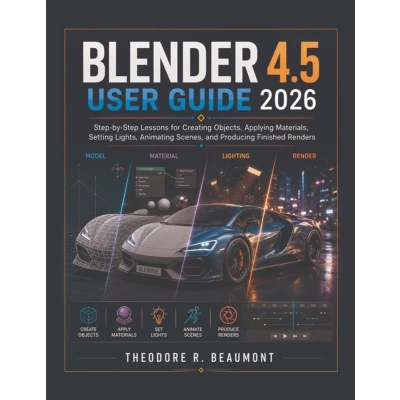
Most beginners don't get stuck because they cannot find Blender's tools.They get stuck because they know how to add an object, change a setting, or follow a short tutorial-but they still don't know how those actions become a finished scene.Blender 4.5 User Guide 2026 is designed to close that gap.The lessons follow the natural life of a 3D project: establish the workspace, shape the geometry, give surfaces character, control the light, position the camera, introduce movement, and finally turn the scene into an image or sequence worth showing.Instead of treating modeling, shading, lighting, and animation as unrelated subjects, this guide helps you see how one decision affects the next. A beautifully modeled object can still look flat under weak lighting. A convincing material can fail if its scale or texture treatment is wrong. An animation can feel awkward even when every keyframe technically works. A render can take too long because decisions that should have been made earlier were left until the end.You'll move from simple geometry into more controlled forms, learn how objects behave in three-dimensional space, organize a growing scene, understand textures and surface appearance, shape illumination rather than merely adding lamps, compose through the camera, introduce motion with greater purpose, and prepare final output with a clearer idea of what the renderer is actually being asked to calculate.The emphasis is on learning through finished work.That makes the book useful for newcomers exploring 3D art, hobbyists who have completed scattered online tutorials but still feel uncertain on their own, aspiring game-asset creators, students experimenting with digital visualization, and anyone who wants to turn a blank viewport into a complete small project without constantly wondering what should happen next.You do not need to know every Blender feature before you can make worthwhile work. You need a dependable sequence of decisions-and enough understanding to recognize when a scene needs better geometry, stronger composition, different surface treatment, more deliberate lighting, or simply fewer unnecessary complications.By the final stages, the goal is not merely to know where tools are located.It is to be able to look at an unfinished scene and know what it needs next.Open the blank viewport, build the first object, and use this guide to carry the idea all the way from simple geometry to the finished frame.
 Prijshistorie
* Prijshistorie bevat geen data van Amazon, Amazon Marketplace.
Prijzen voor het laatst bijgewerkt op:
 Gerelateerde resultaten
 Productspecificaties


