


€ 96,99 Gratis verzending

Uitgelicht
|
|
96,99 |
Naar shop
|
| VERGELIJK ALLE AANBIEDERS (1) | ||
 Beschrijving
Vergelijk aanbieders (1)
€ 96,99 Gratis verzending
Winkels met andere maten
Beschrijving
(1)
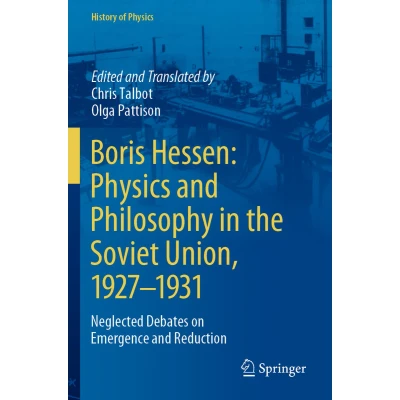
This book presents key works of Boris Hessen, outstanding Soviet philosopher of science, available here in English for the first time. Boris Hessen is known in history of science circles for his “Social and Economic Roots of Newton’s Principia” presented in London (1931), which inspired new approaches in the West. This book presents key works of Boris Hessen, outstanding Soviet philosopher of science, available here in English for the first time. Quality translations are accompanied by an editors' introduction and annotations. Boris Hessen is known in history of science circles for his “Social and Economic Roots of Newton’s Principia” presented in London (1931), which inspired new approaches in the West. As a philosopher and a physicist, he was tasked with developing a Marxist approach to science in the 1920s. He studied the history of physics to clarify issues such as reductionism and causality as they applied to new developments. With the philosophers called the “Dialecticians”, his debates with the opposing “Mechanists” on the issue of emergence are still worth studying and largely ignored in the many recent works on this subject. Taken as a whole, the book is a goldmine of insights into both the foundations of physics and Soviet history. This book presents key works of Boris Hessen, outstanding Soviet philosopher of science, available here in English for the first time. Quality translations are accompanied by an editors' introduction and annotations. Boris Hessen is known in history of science circles for his “Social and Economic Roots of Newton’s Principia” presented in London (1931), which inspired new approaches in the West. As a philosopher and a physicist, he was tasked with developing a Marxist approach to science in the 1920s. He studied the history of physics to clarify issues such as reductionism and causality as they applied to new developments. With the philosophers called the “Dialecticians”, his debates with the opposing “Mechanists” on the issue of emergence are still worth studying and largely ignored in the many recent works on this subject. Taken as a whole, the book is a goldmine of insights into both the foundations of physics and Soviet history.
 Productspecificaties
| EAN |
|
|---|---|
| Maat |
|
 Prijshistorie
 Prijzen voor het laatst bijgewerkt op:
 Gerelateerde resultaten


