


gebruikt € 11,50 Gratis verzending

Uitgelicht
|
|
11,50 |
Naar shop
|
| VERGELIJK ALLE AANBIEDERS (1) | ||
 Beschrijving
Vergelijk aanbieders (1)
gebruikt € 11,50 Gratis verzending
Winkels met andere maten
Beschrijving
(1)
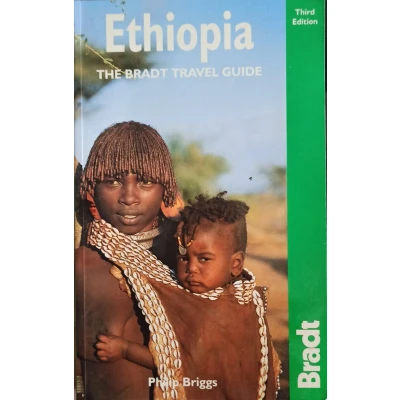
My first contact with things Ethiopian carne by chance, when a friend used a meal at a Nairobi restaurant run by Ethiopian refugees. The food alone was extraordinary delictous fiery orange stew called kai wat, splattered on what looked hike a piece of foam rubber with the lateral dimensions of a bicycle tyre and was apparently called injera but even that didn't prepare me for what was to follow. A troupe of white-robed musicians approached our table and erupted înto smìrkìng discord. Then, signalled by an alarming vibrato shriek, all hell burst loose in the form of a solitary Ethiopian dancer. Her mouth was contorted into the sort of psychotically rapturous grimace you'd expect from Jack Nicholson at his most hammy. Her eyes glowed. Her shoulders jerked and twitched to build up a manic, distocating rhythm. Beneath her robe — driven, presumably, by her metronomic shoulders — a pair of diminutive breasts somehow contrived to flap up and down with an agitated regularity suggestive of a sparrow trapped behind a closed window. 1 left that room with one overwhelming impression: Ethiopians are completely bonkers. 1 knew, too, that I had to visit their country. In July 1994, I found myself flying to Addis Ababa to research this guide. In the months that followed, I discovered Ethiopia to be every bit as fantastic as I had hoped: culturally, historically and scenically, it is the most extraordinary country Ì have ever visited. And since returning home, infatuated to the point of obsession, 1 have discovered that it is impossible to talk about Ethiopia without first saying what it is not. Ethiopia has become practically synonymous with famine and desert, to the extent that the sales manager of Ethiopian Airlines’ Johannesburg office regularly receives tactful enquiries about what, if any, food is served on their flighss. That, in a continent plagued by drought and erratic rainfall, one particular famine has left the world with the misconception that Ethiopia is nothing but a desert says much about the workings of the mass media. It says rather less about Ethiopia. Contrary to Western myth, the elevated central plateau which covers half of Ethiopia’s surface area and supports the large majority of the population is quite possibly the most extensive contiguous area of fertile land in the eastern side of Africa. The deserts do exist, stretching from the base of the plateau to the Kenyan border and the Red Sea and Somali coast, but they are, as you might expect, thìnly populated; they have little impact on the life of most Ethiopians — and they are most unlikely to be visited by tourists. To all intents and purposes, the fertile highland plateau is Ethiopia. Ethiopia'’s fledgeling tourist industry revolves around the richest historical heritage in sub-Saharan Africa. The town of Axum was, from the Ast to 7th centuries AD, the centre of an empire which stretched from the Nile River across the Red Sea to Yemen. The medieval capital of Lalibela boasts a cluster of monolithic rock-hewn churches which is regarded by many as the unofficial eighth wonder of the world. There is also Gonder, the site of five 17th-century castles built by King Fasil and his successors. And all around the country arc Inte. visited monasteries and rock-hewn churches, many of them over 1,000 years old and still in active use. TRANSCRIPTION OF ETHIOPIAN NAMES Ethiopians use a unique script to transcribe Amharigna and several other languages. This has led to a wide divergence In English transcriptions of Ethiopian place names and other Amharigna words, and also Inconsistent use of double characters. Even a straightforward place name like Matu is spelt variously as Metu, Mattuu etc, while names like Zikwala can become virtually unrecognisable (Zouguela). When consulting different books and maps, it's advisable to keep an eye open for varied spellings and to use your imagination. My policy In this book has been to go for the simplest spelling, or the one that to me sounds closest to the local pronunciation. | have stuck with Ethiopianised versions of names: for instance Tewodros (Theodore), Yohannis (John), Maryam (Mary) and Giorgis (George). The exception is that If hotels or restaurants are signposted in English, then | have followed their spelling exactly. Historical sites are the focal point of tourism in Ethiopia, but they threaten at times to be swamped by the breathtaking scenery which fills your peripheral vision. Every bus trip in the Ethiopian highlands is a visual treat, whether you are snaking into the Îkm-deep Blue Nile Gorge, rolling past the sculpted sandstone chffs and valleys of Tigray, undulating over the grassy moorland and culuvated fields of the central highlands, winding through the lush forests of the west and south, or belting across the Rift Valley floor, its acacia scrub dotted by extinct volcanoes, crumbling lava flows and beautiful lakes, and hemrmed in by the sheer walls of the Rift Escarpment. Mere words cannot do justice to Ethiopia's scenery. Isolated from similar habitats by the fringing deserts, the Ethiopian highlands have a remarkably high level of biological endemicity. Large mammals such as the Simien fox, mountain nyala, walia ibex and gelada baboon are found nowhere but Ethiopia, as are 30 of the 800-plus birds which have been recorded in the county This makes national parks like Bale and Simien a paradise for natural-history enthusiasts, as well as for the hikers and mule trekkers who visit them for ther scenery. Over a period of time, Ethiopta’s recognised tourist attractions become incidental to the thrill of just being in this most extraordinary country. The people of the highlands have assimilated a variety of African, Judaic and even Epypuan influences to form one of the most unusual and self-contained cultures on this planet. Dervla Murphy said in 1968 that travelling in Ethiopia gives one the Orlando-like illusion of living through different centuries’. This remains the cast. the independence of spirit which made Ethiopia the one country to emergt uncolonised from the 19th-century scramble for Africa is still its most compelling attraction; even today, there is a sense of otherness to Ethiopia that is & intoxicating as it is elusive. Practically every tangible facet of Ethiopian culture 5 unique. Obscured by the media-refracted glare of the surrounding desert. Ethiopia feels like the archetypal forgotten land. Ethiopia confounds every expectation. You arrive expecting a vast featureless desert and instead find yourself overwhelmed by majestic landscapes and climat abundance. You expect a land which has been ravaged to the point of ruin by years of civil war, and instead you find close to the best civil amenities in Africa and almost no obvious signs that a war ever took place. You arrive expecting to see human degradation and abject poverty, and instead find yourself immersed in 4 culture besorted with itself and its history, and marked by a sense of unforced pride that is positively infectious, Ethiopia is a true revelation. Ît is the most welcorning, enjoyable and uplifting country | have ever visited. For independent travellers, the combination of good, inexpensive facilities and practically limitless opportunities for off-the-beaten« track diverstons makes Ethiopia among the most rewarding and attractive countries ìn Africa. When the world taps its feet, Ethiopia, I suspect, will always breakdance with its shoulders,
 Productspecificaties
| EAN |
|
|---|---|
| Maat |
|
 Gerelateerde resultaten


