








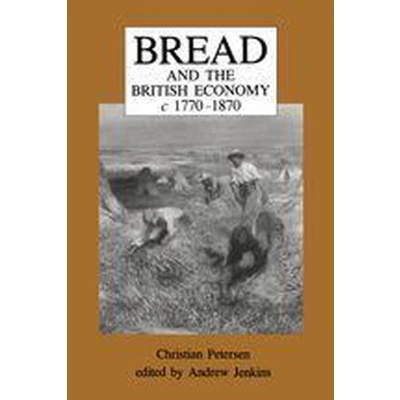
Bread and the British Economy, 17701870
Uitgelicht

|
65,99 |
Naar shop
|

|
124,57 |
Naar shop
|
 Beschrijving
Bol Partner
An analysis of bread as a food and as a socio-economic factor in the British economy in the period 1770 to 1870. It covers cost efficiency and nutritional factors, flour production, market changes and manipulation, consumers and socio-economic groups, the transport of bread, and other matters. In this ambitious book Christian Petersen has taken a central topic in economic and social history and given it a new sweep and coherence. As the Lord’s Prayer suggests, securing an adequate supply of bread was a matter of over-riding concern to everyone until very recently. Bread was always by far the largest single item in the budgets of the poor, but bread could be made from many grains - wheat, rye, barley etc. Christian Petersen describes how in the later eighteenth century the process of replacing other cereals by wheat in bread making was completed throughout Britain. He provides a continuous series of estimates of bread consumption per caput, of bread prices (and, consequently, used in conjunction with population data, of total national expenditure on bread), and of wheat output and net imports. The implications of the changes in techniques of milling and baking that occurred are analysed, and the organisation of the baking and retailing of bread is described. Bread was so central to the economy of individual households and to the national economy as a whole that this book represents a major contribution to the history of the British economy and of British society in the period 1770-1870.


 Beschrijving
(2)
Beschrijving
(2)
An analysis of bread as a food and as a socio-economic factor in the British economy in the period 1770 to 1870. It covers cost efficiency and nutritional factors, flour production, market changes and manipulation, consumers and socio-economic groups, the transport of bread, and other matters. In this ambitious book Christian Petersen has taken a central topic in economic and social history and given it a new sweep and coherence. As the Lord’s Prayer suggests, securing an adequate supply of bread was a matter of over-riding concern to everyone until very recently. Bread was always by far the largest single item in the budgets of the poor, but bread could be made from many grains - wheat, rye, barley etc. Christian Petersen describes how in the later eighteenth century the process of replacing other cereals by wheat in bread making was completed throughout Britain. He provides a continuous series of estimates of bread consumption per caput, of bread prices (and, consequently, used in conjunction with population data, of total national expenditure on bread), and of wheat output and net imports. The implications of the changes in techniques of milling and baking that occurred are analysed, and the organisation of the baking and retailing of bread is described. Bread was so central to the economy of individual households and to the national economy as a whole that this book represents a major contribution to the history of the British economy and of British society in the period 1770-1870.
BolIn this ambitious book Christian Petersen has taken a central topic in economic and social history and given it a new sweep and coherence. As the Lord’s Prayer suggests, securing an adequate supply of bread was a matter of over-riding concern to everyone until very recently. Bread was always by far the largest single item in the budgets of the poor, but bread could be made from many grains - wheat, rye, barley etc. Christian Petersen describes how in the later eighteenth century the process of replacing other cereals by wheat in bread making was completed throughout Britain. He provides a continuous series of estimates of bread consumption per caput, of bread prices (and, consequently, used in conjunction with population data, of total national expenditure on bread), and of wheat output and net imports. The implications of the changes in techniques of milling and baking that occurred are analysed, and the organisation of the baking and retailing of bread is described. Bread was so central to the economy of individual households and to the national economy as a whole that this book represents a major contribution to the history of the British economy and of British society in the period 1770-1870.
 Productspecificaties
| EAN |
|
|---|---|
| Maat |
|
 Prijshistorie
Prijzen voor het laatst bijgewerkt op:
 Gerelateerde resultaten


