
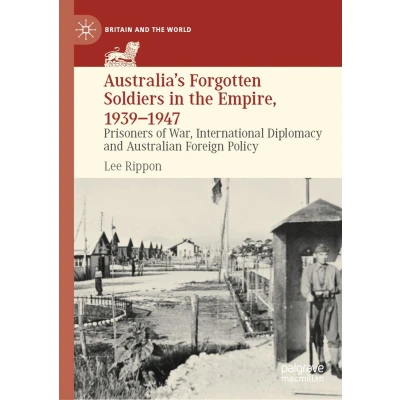
Britain and the World Australia's Forgotten Soldiers in Empire, 19391947
Uitgelicht

|
145,00 |
Naar shop
|
| VERGELIJK ALLE AANBIEDERS (1) | ||
 Beschrijving
Bol
This book explores how Australia managed the prisoner of war issue throughout the Second World War and the immediate post-war period. This book explores how Australia managed the prisoner of war issue throughout the Second World War and the immediate post-war period. It examines how the Australian government responded to the captivity of thousands of Australians in Italy and the detention of an even greater number of Italians in Australia. The war, it finds, created a series of diplomatic and political challenges for belligerent governments, including Australia. The author contends that Australia’s response was guided not only by other pragmatic considerations such as reciprocity, the practicalities of war and, importantly, national interest. The Australian government was not the only one to manage its prisoner of war policy in this way. By exploring the Australian government’s relationship with Britain as part of the British Empire, this book clarifies under what circumstances and to what extent Australia sought to assert a level of independence in pursuing its national interest, even when that approach did not align with British policy. Lee Rippon is an early career historian and academic tutor at Flinders University in Adelaide, Australia. Her research focuses on Australia’s military and political contribution to the empire during the Second World War. This book explores how Australia managed the prisoner of war issue throughout the Second World War and the immediate post-war period. It examines how the Australian government responded to the captivity of thousands of Australians in Italy and the detention of an even greater number of Italians in Australia. The war, it finds, created a series of diplomatic and political challenges for belligerent governments, including Australia. The author contends that Australia’s response was guided not only by other pragmatic considerations such as reciprocity, the practicalities of war and, importantly, national interest. The Australian government was not the only one to manage its prisoner of war policy in this way. By exploring the Australian government’s relationship with Britain as part of the British Empire, this book clarifies under what circumstances and to what extent Australia sought to assert a level of independence in pursuing its national interest, even when that approach did not align with British policy.


Vergelijk aanbieders (1)

 Beschrijving
(1)
Beschrijving
(1)
This book explores how Australia managed the prisoner of war issue throughout the Second World War and the immediate post-war period. This book explores how Australia managed the prisoner of war issue throughout the Second World War and the immediate post-war period. It examines how the Australian government responded to the captivity of thousands of Australians in Italy and the detention of an even greater number of Italians in Australia. The war, it finds, created a series of diplomatic and political challenges for belligerent governments, including Australia. The author contends that Australia’s response was guided not only by other pragmatic considerations such as reciprocity, the practicalities of war and, importantly, national interest. The Australian government was not the only one to manage its prisoner of war policy in this way. By exploring the Australian government’s relationship with Britain as part of the British Empire, this book clarifies under what circumstances and to what extent Australia sought to assert a level of independence in pursuing its national interest, even when that approach did not align with British policy. Lee Rippon is an early career historian and academic tutor at Flinders University in Adelaide, Australia. Her research focuses on Australia’s military and political contribution to the empire during the Second World War. This book explores how Australia managed the prisoner of war issue throughout the Second World War and the immediate post-war period. It examines how the Australian government responded to the captivity of thousands of Australians in Italy and the detention of an even greater number of Italians in Australia. The war, it finds, created a series of diplomatic and political challenges for belligerent governments, including Australia. The author contends that Australia’s response was guided not only by other pragmatic considerations such as reciprocity, the practicalities of war and, importantly, national interest. The Australian government was not the only one to manage its prisoner of war policy in this way. By exploring the Australian government’s relationship with Britain as part of the British Empire, this book clarifies under what circumstances and to what extent Australia sought to assert a level of independence in pursuing its national interest, even when that approach did not align with British policy.
 Productspecificaties
| EAN |
|
|---|---|
| Maat |
|
 Prijshistorie
Prijzen voor het laatst bijgewerkt op:
 Gerelateerde resultaten


