


€ 9,12 € 2,99 verzendkosten Totaal € 12,11

Uitgelicht
|
|
9,12 |
Naar shop
|
| VERGELIJK ALLE AANBIEDERS (1) | ||
 Beschrijving
Vergelijk aanbieders (1)
€ 9,12 € 2,99 verzendkosten Totaal € 12,11
Winkels met andere maten
Beschrijving
(1)
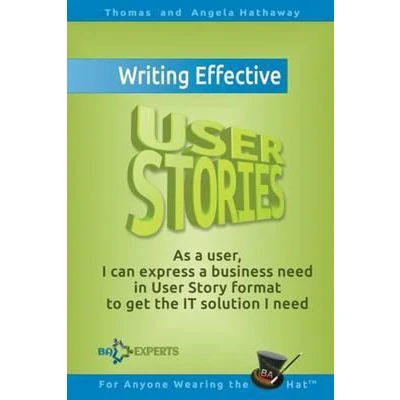
Description User Stories are a great method for expressing stakeholder requirements, whether your projects follow an Agile, Iterative, or a Waterfall methodology. This book presents two common User Story structures to help you ensure that your User Stories have all the required components and that they express the true business need as succinctly as possible. It offers 5 simple rules to ensure that your User Stories are the best that they can be. That, in turn, will reduce the amount of time needed in User Story elaboration and discussion with the development team. After reading this book you will be able to: Translate business needs into well-structured User Stories Write User Stories that express the what and avoid the how Apply five simple rules for writing effective User Stories Clarify assumptions in User Stories by adding context Identify and remove ambiguous and subjective terms and phrases in User Stories Select the appropriate format for expressing User Stories for Agile Projects Write stakeholder requirements in User Story format that solve business problems Elaborate User Stories to identify measurable non-functional requirementsAuthors Note The term User Story is a relative new addition to our language and its definition is evolving. In todays parlance, a complete User Story has three primary components, namely the ''Card'', the ''Conversation'', and the ''Criteria''. Different roles are responsible for creating each component. The Card expresses a business need. A representative of the business community is responsible for expressing the business need. Historically (and for practical reasons) the Card is the User Story from the perspective of the business community. Since we wrote this book specifically to address that audience, we use the term User Story in that context throughout. The Conversation is an ongoing discussion between a developer responsible for creating software that meets the business need and the domain expert(s) who defined it (e.g., the original author of the Card). The developer initiates the Conversation with the domain expert(s) to define the Criteria and any additional information the developer needs to create the application. There is much to be written about both the Conversation and the Criteria, but neither component is dealt with in any detail in this publication. A well-written User Story (Card) can drastically reduce the time needed for the Conversation. It reduces misinterpretations, misunderstandings, and false starts, thereby paving the way for faster delivery of working software. We chose to limit the content of this publication to the User Story as understood by the business community to keep the book focused and address the widest possible audience.
 Productspecificaties
| EAN |
|
|---|---|
| Maat |
|
 Prijshistorie
 Prijzen voor het laatst bijgewerkt op:
 Gerelateerde resultaten


