
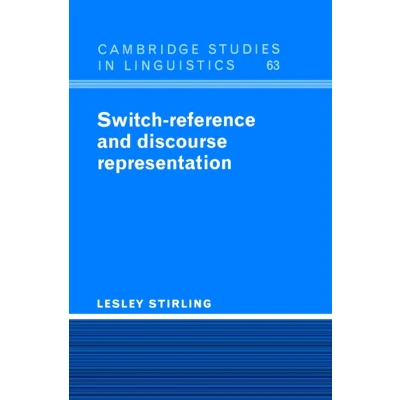
Cambridge Studies in LinguisticsSeries Number 63 Switch Reference and Discourse Representation
Uitgelicht

|
56,99 |
Naar shop
|
| VERGELIJK ALLE AANBIEDERS (1) | ||
 Beschrijving
Bol
In central cases of switch-reference, a marker on the verb of one clause is used to indicate whether its subject has the same or different reference from the subject of an adjacent, syntactically related clause. In central cases of logophoricity, a special pronoun form is used within a reported speech context, to indicate coherence with the source of reported speech. Lesley Stirling argues that these types of anaphoric linkage across clause boundaries cannot be adequately accounted for by Binding Theory. Her detailed examination of the two phenomena, including a case study of the Papuan language Amele, proposes an account for them which is formalized in Discourse Representation Theory, and explores how far it is possible for such an account to be compositional morpho-syntactic/semantic, while at the same time taking seriously the range of linguistic and cross-linguistic data to be explained. Switch-reference's indication of agreement or disagreement between clauses (or larger discourse units) is shown to function along various parameters contributing to discourse continuity: their major protagonists, spatial and temporal location, and their status as describing actual or non-actual situations. The arguments bear also on general debates around the nature of linguistically marked referential relations and the analysis of logophoric phenomena.


Vergelijk aanbieders (1)

 Beschrijving
(1)
Beschrijving
(1)
In central cases of switch-reference, a marker on the verb of one clause is used to indicate whether its subject has the same or different reference from the subject of an adjacent, syntactically related clause. In central cases of logophoricity, a special pronoun form is used within a reported speech context, to indicate coherence with the source of reported speech. Lesley Stirling argues that these types of anaphoric linkage across clause boundaries cannot be adequately accounted for by Binding Theory. Her detailed examination of the two phenomena, including a case study of the Papuan language Amele, proposes an account for them which is formalized in Discourse Representation Theory, and explores how far it is possible for such an account to be compositional morpho-syntactic/semantic, while at the same time taking seriously the range of linguistic and cross-linguistic data to be explained. Switch-reference's indication of agreement or disagreement between clauses (or larger discourse units) is shown to function along various parameters contributing to discourse continuity: their major protagonists, spatial and temporal location, and their status as describing actual or non-actual situations. The arguments bear also on general debates around the nature of linguistically marked referential relations and the analysis of logophoric phenomena.
 Productspecificaties
| EAN |
|
|---|---|
| Maat |
|
 Prijshistorie
Prijzen voor het laatst bijgewerkt op:
 Gerelateerde resultaten


