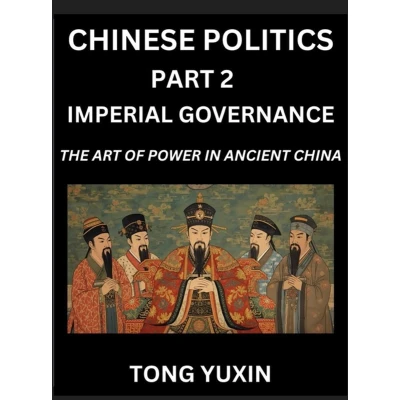



€ 52,79 Gratis verzending

Uitgelicht
|
|
52,79 |
Naar shop
|

|
73,50 |
Naar shop
|

|
73,50 |
Naar shop
|
| VERGELIJK ALLE AANBIEDERS (3) | ||
 Beschrijving
Vergelijk aanbieders (3)
€ 52,79 Gratis verzending
€ 73,50 Gratis verzending
€ 73,50 Gratis verzending
Winkels met andere maten
Beschrijving
(1)
For centuries, the governance of ancient China was far more than a system of rules-it was a living philosophy, a dance between heaven and earth, where emperors sought not just to rule but to embody cosmic order. The concept of ¿¿ (ti¿nmìng, "Mandate of Heaven") was more than a claim to power; it was a moral contract, a promise that the ruler's authority depended on their virtue and wisdom. This book delves into the heart of "Imperial Governance", revealing how rulers, ministers, and scholars wove ethics, strategy, and ritual into the fabric of daily rule.At its foundation lay ¿ (dé, "virtue") and ¿ (l¿, "ritual")-principles that governed everything from court ceremonies to tax policies. The "Art of Power" was not about brute force but about persuasion, about making the people believe in the emperor's divine right to lead. Yet beneath this idealism lay a world of ¿¿ (quánmóu, "strategic maneuvering"), where emperors balanced alliances, suppressed rebellions, and outmaneuvered rivals to survive.This work traces the evolution of governance across dynasties: the ¿ (Zh¿u) Dynasty's feudal order, where local lords held power under heaven's gaze; the ¿ (Qín) Empire's legalist revolution, which centralized authority with an iron fist; and the ¿ (Táng) Dynasty's golden age, where bureaucracy and cosmopolitanism flourished. Along the way, we see how ¿¿ (k¿j¿, "imperial examinations") transformed China's elite, turning scholars into statesmen and reshaping the very nature of power.But governance was never static. The tension between ¿¿ (zh¿ngy¿ng, "central") control and ¿¿ (dìf¿ng, "local") autonomy echoed through every decree, every rebellion, every reform. Some emperors ruled with ¿¿ (rénzhèng, "benevolence"), winning loyalty through fairness; others relied on fear, only to see their dynasties crumble.This is not a story of simple "autocracy." It is a tale of innovation-of how rulers adapted to crises, borrowed ideas from rivals, and reinvented governance to suit their times. Whether through the ¿¿ (F¿ji¿, "Legalist") harshness of the Qín or the ¿¿ (Rúji¿, "Confucian") flexibility of the Song, the art of power in ancient China was always evolving, always contested. And in its lessons, we find echoes of modern struggles over authority, legitimacy, and the limits of rule.
 Prijshistorie
 * Prijshistorie bevat geen data van Amazon, Amazon Marketplace.
Prijzen voor het laatst bijgewerkt op:
 Gerelateerde resultaten
 Productspecificaties


