


€ 22,24 € 2,99 verzendkosten Totaal € 25,23

Gesponsorde links
|
|
22,24 |
Naar shop
|

|
22,99 |
Naar shop
|

|
22,99 |
Naar shop
|
| VERGELIJK ALLE AANBIEDERS (3) | ||
 Beschrijving
Vergelijk aanbieders (3)
Gesponsorde links · Sommige shops betalen ons een vergoeding
€ 22,24 € 2,99 verzendkosten Totaal € 25,23
€ 22,99 Gratis verzending
€ 22,99 Gratis verzending
Winkels met andere maten
Beschrijving
(1)
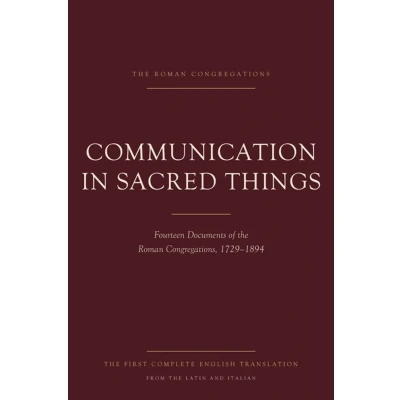
The first complete English translation of fourteen documents of the Roman congregations, 1729-1894.Between 1729 and 1894 the Roman congregations were asked, again and again, what a Catholic may do when he lives among people who are not Catholics.The questions did not arrive as theses. They arrived as difficulties from men who had to answer them by Friday. May the Catholics of Antivari walk in procession behind the schismatics? May a Latin priest let a Greek priest say Mass in his church? May the Catholic clergy of Santorini walk under the canopy with a Lutheran king? May a boy in a Russian gymnasium kiss the cross a non-Catholic minister holds out to him, when the alternative is expulsion?And behind those, a harder set. When a convert comes from a sect that mocks the very idea that baptism does anything - is he baptised? When a bishop who was once a schismatic confesses that in those years he never once meant to baptise the children he baptised, what happens to everyone he touched?What the reader meets here is not the speculation of theologians but the ordinary and authoritative teaching of the Roman congregations, handed down consistently for centuries and governing Catholic practice until 1965. The same principles are applied by the same authority in Corfu and in Kentucky, in Siam and in the Cyclades, in Ceylon and in Washington Territory: the answers vary with the facts, never with the doctrine.Here are fourteen answers, translated from the printed pages of the Collectanea S. Congregationis de Propaganda Fide (Rome, 1907).The Instruction of 1729 states the principle: the prohibition of communication in sacred things rests on natural and divine law, "in which there is no power that may dispense, nor any connivance that may excuse." The rest apply that principle to particular cases, and the answers are graded with precision - what is simply unlawful, what may be tolerated, what may be dissembled, and what may be done only in danger of death when no Catholic priest can be had. In 1877 the Holy Office told the Bishop of Nesqually that he might not reason from what the Methodists believe to what their ministers must therefore have done: abusus non esse praesumendos sed probandos, abuses are not to be presumed but proved.Running through the whole collection is a third category that has dropped out of the modern argument: dissimulatio, the deliberate decision of a superior not to enforce a law he cannot enforce without harming the people it exists to protect. It is never a dispensation, and it is usually hedged by the condition remoto scandalo, scandal being removed.Each document is given with its volume, entry number and printed page, so any passage can be checked against the Latin in seconds. A hundred footnotes record translation choices, textual difficulties in the 1907 edition, and the historical detail a reader needs. With an introduction, a glossary of the technical vocabulary, and a table of sources.
 Prijshistorie
* Prijshistorie bevat geen data van Amazon, Amazon Marketplace.
Prijzen voor het laatst bijgewerkt op:
 Gerelateerde resultaten
 Productspecificaties


