
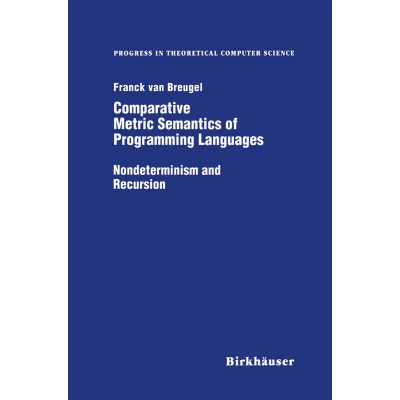
Comparative Metric Semantics of Programming Languages
Uitgelicht

|
119,00 |
Naar shop
|
| VERGELIJK ALLE AANBIEDERS (1) | ||
 Beschrijving
Bol
During the last three decades several different styles of semantics for program ming languages have been developed. Besides non determinism our four example languages contain some form of recursion, a key ingredient of programming languages. During the last three decades several different styles of semantics for program ming languages have been developed. This book compares two of them: the operational and the denotational approach. On the basis of several exam ples we show how to define operational and denotational semantic models for programming languages. Furthermore, we introduce a general technique for comparing various semantic models for a given language. We focus on different degrees of nondeterminism in programming lan guages. Nondeterminism arises naturally in concurrent languages. It is also an important concept in specification languages. In the examples discussed, the degree of non determinism ranges from a choice between two alternatives to a choice between a collection of alternatives indexed by a closed interval of the real numbers. The former arises in a language with nondeterministic choices. A real time language with dense choices gives rise to the latter. We also consider the nondeterministic random assignment and parallel composition, both couched in a simple language. Besides non determinism our four example languages contain some form of recursion, a key ingredient of programming languages.


Vergelijk aanbieders (1)

 Beschrijving
(1)
Beschrijving
(1)
During the last three decades several different styles of semantics for program ming languages have been developed. Besides non determinism our four example languages contain some form of recursion, a key ingredient of programming languages. During the last three decades several different styles of semantics for program ming languages have been developed. This book compares two of them: the operational and the denotational approach. On the basis of several exam ples we show how to define operational and denotational semantic models for programming languages. Furthermore, we introduce a general technique for comparing various semantic models for a given language. We focus on different degrees of nondeterminism in programming lan guages. Nondeterminism arises naturally in concurrent languages. It is also an important concept in specification languages. In the examples discussed, the degree of non determinism ranges from a choice between two alternatives to a choice between a collection of alternatives indexed by a closed interval of the real numbers. The former arises in a language with nondeterministic choices. A real time language with dense choices gives rise to the latter. We also consider the nondeterministic random assignment and parallel composition, both couched in a simple language. Besides non determinism our four example languages contain some form of recursion, a key ingredient of programming languages.
 Productspecificaties
| EAN |
|
|---|---|
| Maat |
|
 Prijshistorie
Prijzen voor het laatst bijgewerkt op:
 Gerelateerde resultaten


