

€ 15,65 Gratis verzending

Gesponsorde links
|
|
15,65 |
Naar shop
|

|
15,65 |
Naar shop
|

|
17,00 |
Naar shop
|
| VERGELIJK ALLE AANBIEDERS (3) | ||
 Beschrijving
Vergelijk aanbieders (3)
Gesponsorde links · Sommige shops betalen ons een vergoeding
€ 15,65 Gratis verzending
€ 15,65 Gratis verzending
€ 17,00 € 2,99 verzendkosten Totaal € 19,99
Winkels met andere maten
Beschrijving
(1)
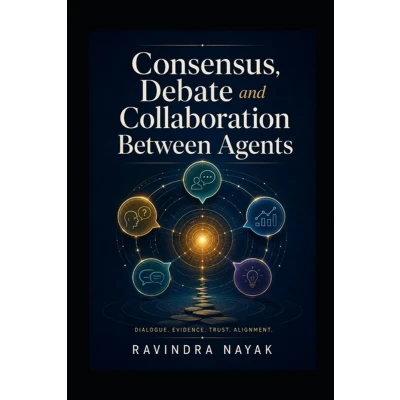
What happens when several AI agents look at the same problem-and disagree?One agent prefers the fastest path. Another sees a risk. A critic challenges the evidence. A judge must decide whether the disagreement is resolved, whether uncertainty should remain visible, or whether the decision belongs with a human. The difficult question is no longer simply whether AI can produce an answer. It is how a collaborative agent system should think when capable components do not see the situation in the same way.Consensus, Debate and Collaboration Between Agents is a first-principles guide for non-technical readers who want to understand multi-agent systems without being buried in code, jargon, or intimidating mathematics. It begins with ordinary decisions and builds one layer at a time: why disagreement can be useful information, when voting helps, why a majority can still be wrong, how weighted influence should be earned, and why confidence is not the same as certainty.From there, the book goes deeper into critic and judge roles, evidence-first debate, minority reports, tie-breaking, coordination, handoffs, decision rights, human review, accountability, recovery, resilience, governance, versioning, drift, and controlled change. The goal is not to make agent collaboration look sophisticated. The goal is to make it inspectable, proportionate, and useful.Throughout the book, Nila and Arun turn abstract ideas into conversations a non-technical reader can follow. Small calculations appear only after the intuition is clear. The mathematics is used as a thinking tool-to make shares, weights, thresholds, uncertainty, trade-offs, and review priorities easier to see-not as a barrier to entry.The final Value Edition turns understanding into practice. Through the Scratch-Layer Loop, chunking exercises, disagreement drills, evidence challenges, decision-right simulations, resilience practice, governance scenarios, brainstorming techniques, and a compact Seven-Card Toolkit, readers learn to rebuild the subject from memory and apply it to unfamiliar problems.This book is for readers who want a calm, structured way to think about agentic AI collaboration: how multiple AI agents can contribute different perspectives without creating louder confusion; how evidence can defeat popularity when it should; how systems can know when to stop debating; and how human judgment and authority remain visible when consequences matter.If multi-agent AI feels complex, begin here. You do not need to memorize the machinery. You need a way to ask the right questions-and a method for turning disagreement into better decisions.
 Prijshistorie
* Prijshistorie bevat geen data van Amazon, Amazon Marketplace.
Prijzen voor het laatst bijgewerkt op:
 Gerelateerde resultaten
 Productspecificaties


