
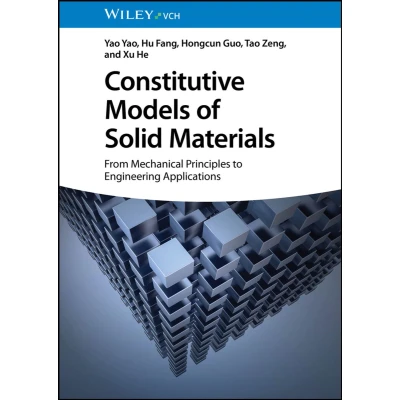
Constitutive Models of Solid Materials: From Mechanical Principles to Engineering Applications
Uitgelicht

|
133,99 |
Naar shop
|

|
133,99 |
Naar shop
|

|
145,00 |
Naar shop
|
| VERGELIJK ALLE AANBIEDERS (3) | ||
 Beschrijving
Bol
Explore constitutive modeling from fundamental theory through cutting-edge AI applications Constitutive Models of Solid Materials: From Mechanical Principles to Engineering Applications provides researchers and engineers with comprehensive methods to predict material responses under complex loading conditions. Written by internationally recognized experts in materials mechanics and computational methods, this systematic treatment connects rigorous theoretical foundations to practical engineering applications, demonstrating the accurate modeling of material behavior across multiple scales. The text progresses methodically from tensor analysis and continuum mechanics through elasticity, plasticity, and damage mechanics to micromechanics and numerical implementation strategies. Coverage extends to artificial intelligence integration in constitutive research, featuring Physics-Informed Neural Networks for constitutive parameter prediction. Four detailed case studies examine sintered nano-silver, high-strength steel, solder alloys, rock modeling, and high-temperature concrete performance. The book offers: Comprehensive coverage from mathematical foundations through elastoplastic theory, damage mechanics, and micromechanics to AI-enhanced modeling approaches Numerical implementation strategies including time-stepping schemes, Newton-Raphson iteration, and elastic predictor plastic corrector methods for simulations Detailed case studies on sintered nano-silver, high-strength steels, solder alloys, rocks, and concrete under extreme conditions Integration of machine learning including Artificial Neural Networks, XGBoost, and Physics-Informed Neural Networks with example programs Multiscale frameworks combining Eshelby’s theory, Hill’s method, and homogenization techniques linking microstructure to macroscopic behavior This comprehensive resource serves materials scientists, mechanical engineers, civil engineers, aerospace professionals, and graduate students seeking to master constitutive modeling. By combining rigorous mathematical formulation with computational methods and practical case studies, it provides an essential foundation for advanced materials research and engineering practice. Explore constitutive modeling from fundamental theory through cutting-edge AI applications Constitutive Models of Solid Materials: From Mechanical Principles to Engineering Applications provides researchers and engineers with comprehensive methods to predict material responses under complex loading conditions. Written by internationally recognized experts in materials mechanics and computational methods, this systematic treatment connects rigorous theoretical foundations to practical engineering applications, demonstrating the accurate modeling of material behavior across multiple scales. The text progresses methodically from tensor analysis and continuum mechanics through elasticity, plasticity, and damage mechanics to micromechanics and numerical implementation strategies. Coverage extends to artificial intelligence integration in constitutive research, featuring Physics-Informed Neural Networks for constitutive parameter prediction. Four detailed case studies examine sintered nano-silver, high-strength steel, solder alloys, rock modeling, and high-temperature concrete performance. The book offers: Comprehensive coverage from mathematical foundations through elastoplastic theory, damage mechanics, and micromechanics to AI-enhanced modeling approaches Numerical implementation strategies including time-stepping schemes, Newton-Raphson iteration, and elastic predictor plastic corrector methods for simulations Detailed case studies on sintered nano-silver, high-strength steels, solder alloys, rocks, and concrete under extreme conditions Integration of machine learning including Artificial Neural Networks, XGBoost, and Physics-Informed Neural Networks with example programs Multiscale frameworks combining Eshelby’s theory, Hill’s method, and homogenization techniques linking microstructure to macroscopic behavior This comprehensive resource serves materials scientists, mechanical engineers, civil engineers, aerospace professionals, and graduate students seeking to master constitutive modeling. By combining rigorous mathematical formulation with computational methods and practical case studies, it provides an essential foundation for advanced materials research and engineering practice.


 Beschrijving
(1)
Beschrijving
(1)
Explore constitutive modeling from fundamental theory through cutting-edge AI applications Constitutive Models of Solid Materials: From Mechanical Principles to Engineering Applications provides researchers and engineers with comprehensive methods to predict material responses under complex loading conditions. Written by internationally recognized experts in materials mechanics and computational methods, this systematic treatment connects rigorous theoretical foundations to practical engineering applications, demonstrating the accurate modeling of material behavior across multiple scales. The text progresses methodically from tensor analysis and continuum mechanics through elasticity, plasticity, and damage mechanics to micromechanics and numerical implementation strategies. Coverage extends to artificial intelligence integration in constitutive research, featuring Physics-Informed Neural Networks for constitutive parameter prediction. Four detailed case studies examine sintered nano-silver, high-strength steel, solder alloys, rock modeling, and high-temperature concrete performance. The book offers: Comprehensive coverage from mathematical foundations through elastoplastic theory, damage mechanics, and micromechanics to AI-enhanced modeling approaches Numerical implementation strategies including time-stepping schemes, Newton-Raphson iteration, and elastic predictor plastic corrector methods for simulations Detailed case studies on sintered nano-silver, high-strength steels, solder alloys, rocks, and concrete under extreme conditions Integration of machine learning including Artificial Neural Networks, XGBoost, and Physics-Informed Neural Networks with example programs Multiscale frameworks combining Eshelby’s theory, Hill’s method, and homogenization techniques linking microstructure to macroscopic behavior This comprehensive resource serves materials scientists, mechanical engineers, civil engineers, aerospace professionals, and graduate students seeking to master constitutive modeling. By combining rigorous mathematical formulation with computational methods and practical case studies, it provides an essential foundation for advanced materials research and engineering practice. Explore constitutive modeling from fundamental theory through cutting-edge AI applications Constitutive Models of Solid Materials: From Mechanical Principles to Engineering Applications provides researchers and engineers with comprehensive methods to predict material responses under complex loading conditions. Written by internationally recognized experts in materials mechanics and computational methods, this systematic treatment connects rigorous theoretical foundations to practical engineering applications, demonstrating the accurate modeling of material behavior across multiple scales. The text progresses methodically from tensor analysis and continuum mechanics through elasticity, plasticity, and damage mechanics to micromechanics and numerical implementation strategies. Coverage extends to artificial intelligence integration in constitutive research, featuring Physics-Informed Neural Networks for constitutive parameter prediction. Four detailed case studies examine sintered nano-silver, high-strength steel, solder alloys, rock modeling, and high-temperature concrete performance. The book offers: Comprehensive coverage from mathematical foundations through elastoplastic theory, damage mechanics, and micromechanics to AI-enhanced modeling approaches Numerical implementation strategies including time-stepping schemes, Newton-Raphson iteration, and elastic predictor plastic corrector methods for simulations Detailed case studies on sintered nano-silver, high-strength steels, solder alloys, rocks, and concrete under extreme conditions Integration of machine learning including Artificial Neural Networks, XGBoost, and Physics-Informed Neural Networks with example programs Multiscale frameworks combining Eshelby’s theory, Hill’s method, and homogenization techniques linking microstructure to macroscopic behavior This comprehensive resource serves materials scientists, mechanical engineers, civil engineers, aerospace professionals, and graduate students seeking to master constitutive modeling. By combining rigorous mathematical formulation with computational methods and practical case studies, it provides an essential foundation for advanced materials research and engineering practice.
 Productspecificaties
 Prijshistorie
* Prijshistorie bevat geen data van Amazon, Amazon Marketplace.
Prijzen voor het laatst bijgewerkt op:
 Gerelateerde resultaten


