
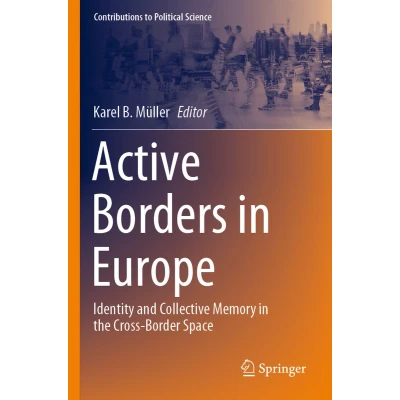
Contributions to Political Science Active Borders in Europe
Uitgelicht

|
125,00 |
Naar shop
|
| VERGELIJK ALLE AANBIEDERS (1) | ||
 Beschrijving
Bol
This book explores how identities, public spheres and collective memories are being transformed in cross-border areas, contributing to the broad sociological context of Europeanization. This book explores how identities, public spheres and collective memories are being transformed in cross-border areas, contributing to the broad sociological context of Europeanization. Offering case studies on the German-Czech-Austrian, and Czech-Polish-German borderlands, the book introduces original primary data on cross-border cooperation. This data is interpreted using the concept of active borders, which approaches borders as a source of multicultural competence and cognitive capacity. In turn, the authors argue that Europeans need to treat borders, both territorial and symbolic, as specific cultural forms. Active borders allow an unprecedented level of cross-border cooperation and integration, and foster a better understanding of differences, rather than re-embedding them or constructing others. Accordingly, the authors contend that active borders promote more dynamic, open and resilient societies, and represent crucial prerequisites for the success of the European integration project. This book explores how identities, public spheres and collective memories are being transformed in cross-border areas, contributing to the broad sociological context of Europeanization. Offering case studies on the German-Czech-Austrian, and Czech-Polish-German borderlands, the book introduces original primary data on cross-border cooperation. This data is interpreted using the concept of active borders, which approaches borders as a source of multicultural competence and cognitive capacity. In turn, the authors argue that Europeans need to treat borders, both territorial and symbolic, as specific cultural forms. Active borders allow an unprecedented level of cross-border cooperation and integration, and foster a better understanding of differences, rather than re-embedding them or constructing others. Accordingly, the authors contend that active borders promote more dynamic, open and resilient societies, and represent crucial prerequisites for the success of the European integration project.


Vergelijk aanbieders (1)

 Beschrijving
(1)
Beschrijving
(1)
This book explores how identities, public spheres and collective memories are being transformed in cross-border areas, contributing to the broad sociological context of Europeanization. This book explores how identities, public spheres and collective memories are being transformed in cross-border areas, contributing to the broad sociological context of Europeanization. Offering case studies on the German-Czech-Austrian, and Czech-Polish-German borderlands, the book introduces original primary data on cross-border cooperation. This data is interpreted using the concept of active borders, which approaches borders as a source of multicultural competence and cognitive capacity. In turn, the authors argue that Europeans need to treat borders, both territorial and symbolic, as specific cultural forms. Active borders allow an unprecedented level of cross-border cooperation and integration, and foster a better understanding of differences, rather than re-embedding them or constructing others. Accordingly, the authors contend that active borders promote more dynamic, open and resilient societies, and represent crucial prerequisites for the success of the European integration project. This book explores how identities, public spheres and collective memories are being transformed in cross-border areas, contributing to the broad sociological context of Europeanization. Offering case studies on the German-Czech-Austrian, and Czech-Polish-German borderlands, the book introduces original primary data on cross-border cooperation. This data is interpreted using the concept of active borders, which approaches borders as a source of multicultural competence and cognitive capacity. In turn, the authors argue that Europeans need to treat borders, both territorial and symbolic, as specific cultural forms. Active borders allow an unprecedented level of cross-border cooperation and integration, and foster a better understanding of differences, rather than re-embedding them or constructing others. Accordingly, the authors contend that active borders promote more dynamic, open and resilient societies, and represent crucial prerequisites for the success of the European integration project.
 Productspecificaties
| EAN |
|
|---|---|
| Maat |
|
 Prijshistorie
Prijzen voor het laatst bijgewerkt op:
 Gerelateerde resultaten


