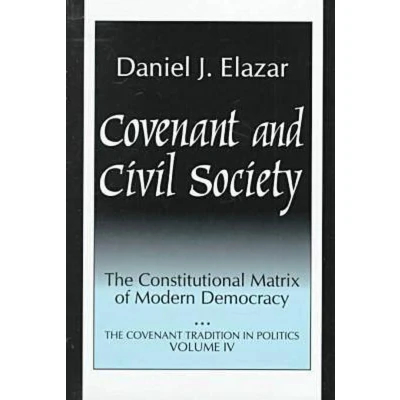

Covenant Traditions in Politics Series and Civil Society

Prijzen vanaf
77,62

Uitgelicht

VERGELIJK ALLE AANBIEDERS (2)

Beschrijving

Bol Partner The essence of the covenant tradition is the idea of human beings freely associating for common purposes through pacts of mutual commitment The essence of the covenant tradition is the idea of human beings freely associating for common purposes through pacts of mutual commitment. In the political realm, the idea of covenant has been particularly influential in frontierlands. Reinformed by the idea of the federated commonwealth that emerged out of the Protestant Reformation, covenant eventually fostered the establishment of the United States of America and our modern idea of federalism. More recently, these great products of the covenant tradition helped to bring about the collapse of twentieth-century totalitarianism and fueled a new spirit in contemporary political life throughout the world. A return to political covenantalism seems to be an appropriate response to the crisis of modern civilization and the new epoch after World War II. Covenant and Civil Society is the final volume in Elazar's monumental series The Covenant Tradition in Politics. In it, he traces the tradition's rebirth and development in the modern epoch.Covenant and Civil Society also considers issues of communal solidarity on a postmodern basis. Elazar traces the transition from the covenanted commonwealth of the Protestant Reformation to the civil society of the modern epoch, and explores the covenant's role in the modern statist era and the development of modern democracy. Scandiriavia, and the Latin-Germanic borderlands, many of which are typically thought of as examples of organic or hierarchical models. Elazar argues that a covenantal model is more appropriate and is part of the Western tradition as such.The book concludes with examination of the present and future of covenantal thought. Today, the global spread of federalism, most clearly seen in the formation of the European Union, is also seen in local and private arenas. Elazar considers the benefits of covenantal thought while balancing such optimism with a realistic sense of its limits. As a prescription for change, Covenant and Civil Society is a fundamental and original contribution. Along with the previous volumes in this series, all available from Transaction, it will be of deep interest to historians, social scientists, political theorists, and theologians of all persuasions.

Vergelijk aanbieders (2)

Shop
Prijs
Verzendkosten
Totale prijs
77,62
Gratis
77,62
Naar shop
Gratis Shipping Costs
178,83
gebruikt
Gratis
178,83
Naar shop
Gratis Shipping Costs
Beschrijving (2)
Bol Partner

The essence of the covenant tradition is the idea of human beings freely associating for common purposes through pacts of mutual commitment The essence of the covenant tradition is the idea of human beings freely associating for common purposes through pacts of mutual commitment. In the political realm, the idea of covenant has been particularly influential in frontierlands. Reinformed by the idea of the federated commonwealth that emerged out of the Protestant Reformation, covenant eventually fostered the establishment of the United States of America and our modern idea of federalism. More recently, these great products of the covenant tradition helped to bring about the collapse of twentieth-century totalitarianism and fueled a new spirit in contemporary political life throughout the world. A return to political covenantalism seems to be an appropriate response to the crisis of modern civilization and the new epoch after World War II. Covenant and Civil Society is the final volume in Elazar's monumental series The Covenant Tradition in Politics. In it, he traces the tradition's rebirth and development in the modern epoch.Covenant and Civil Society also considers issues of communal solidarity on a postmodern basis. Elazar traces the transition from the covenanted commonwealth of the Protestant Reformation to the civil society of the modern epoch, and explores the covenant's role in the modern statist era and the development of modern democracy. Scandiriavia, and the Latin-Germanic borderlands, many of which are typically thought of as examples of organic or hierarchical models. Elazar argues that a covenantal model is more appropriate and is part of the Western tradition as such.The book concludes with examination of the present and future of covenantal thought. Today, the global spread of federalism, most clearly seen in the formation of the European Union, is also seen in local and private arenas. Elazar considers the benefits of covenantal thought while balancing such optimism with a realistic sense of its limits. As a prescription for change, Covenant and Civil Society is a fundamental and original contribution. Along with the previous volumes in this series, all available from Transaction, it will be of deep interest to historians, social scientists, political theorists, and theologians of all persuasions.

Bol

The essence of the covenant tradition is the idea of human beings freely associating for common purposes through pacts of mutual commitment. In the political realm, the idea of covenant has been particularly influential in frontierlands. Reinformed by the idea of the federated commonwealth that emerged out of the Protestant Reformation, covenant eventually fostered the establishment of the United States of America and our modern idea of federalism. More recently, these great products of the covenant tradition helped to bring about the collapse of twentieth-century totalitarianism and fueled a new spirit in contemporary political life throughout the world. A return to political covenantalism seems to be an appropriate response to the crisis of modern civilization and the new epoch after World War II. Covenant and Civil Society is the final volume in Elazar's monumental series The Covenant Tradition in Politics. In it, he traces the tradition's rebirth and development in the modern epoch.Covenant and Civil Society also considers issues of communal solidarity on a postmodern basis. Elazar traces the transition from the covenanted commonwealth of the Protestant Reformation to the civil society of the modern epoch, and explores the covenant's role in the modern statist era and the development of modern democracy. Scandiriavia, and the Latin-Germanic borderlands, many of which are typically thought of as examples of organic or hierarchical models. Elazar argues that a covenantal model is more appropriate and is part of the Western tradition as such.The book concludes with examination of the present and future of covenantal thought. Today, the global spread of federalism, most clearly seen in the formation of the European Union, is also seen in local and private arenas. Elazar considers the benefits of covenantal thought while balancing such optimism with a realistic sense of its limits. As a prescription for change, Covenant and Civil Society is a fundamental and original contribution. Along with the previous volumes in this series, all available from Transaction, it will be of deep interest to historians, social scientists, political theorists, and theologians of all persuasions.


Productspecificaties

EAN
  • 9781351291422
  • 9781560003113
Maat


Prijshistorie

Prijzen voor het laatst bijgewerkt op:

Uitgelichte Keuze
77,62
Naar shop
